



By Francisco Acevedo
HAVANA TIMES – With great fanfare, Cuban media celebrated this week the arrival of the first flight of the spring 2025 season carrying Russian tourists, even as the sector struggles to reach even modest numbers.
On March 28, the first 285 visitors from the largest country in the world arrived at the International Airport in Matanzas. Interestingly, one wouldn’t think that country is at war, as everything outside of Ukrainian territory seems to be business as usual.
The flight, organized by the Russian oil company Rosneft and operated by the airline Nordwind, launched a two-week stay in the Varadero resort. This goes beyond traditional hotel accommodation and includes various activities aimed at boosting Russian tourism, which has seen growth in recent years after virtually disappearing following the fall of the socialist bloc.
However, the reports related to this arrival made no mention of the current state of the “smokeless industry” in Cuba, which has failed to experience the expected rebound after the COVID-19 pandemic.
When the 2024 figures were released, a significant drop was evident compared to 2023. In the past year, 2,203,117 visitors were received—90.4% of the 2,436,980 reported the year before, according to the state-run National Office of Statistics and Information (ONEI).
According to that agency, there was a 2.1% increase in revenue, but the occupancy rate also fell—to just 23%, down from 25% in 2023.
The increase in revenue might be explained by the more luxurious—and clearly more expensive—facilities, such as the newly inaugurated K-23 Tower.
Although Russia is now filling the tourism role once held by the Soviet Union, there were declines in major source markets. Canada (the most significant) reached only 91.9% of the visitors reported in 2023, the Cuban community abroad 82.2%, the United States 89.6%, Germany 94.3%, France 91.5%, Italy 84.1%, Argentina 93.1%, the UK 54.8%, and Spain 72.9%, in order of the total number of visitors from each country.
Increases were seen from Mexico, Portugal, Brazil, Turkey, Peru, and China, but only Mexico managed to send more than 40,000 people—none of the others surpassed 34,000.
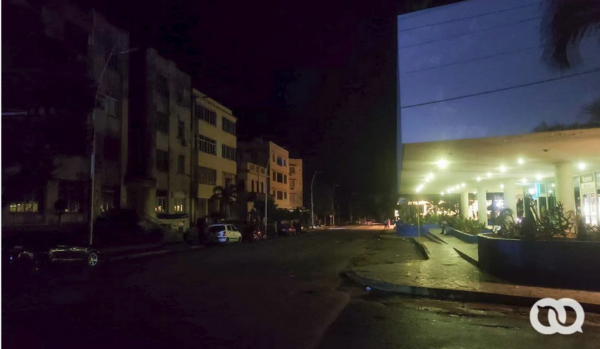
Far from improving, the situation in 2025 appears to be stagnant. Even in the peak season, tourism is sharply declining, with no light at the end of the tunnel.
While the post-pandemic period is showing encouraging numbers around the world, Cuba still cannot get back on its feet. Among the reasons are lack of financing, supplies, and resources, which severely damage the price-quality ratio of the tourism product compared to its regional competitors.
According to Tourism Minister Juan Carlos García, who spoke before the National Assembly in December, a major communication campaign against Cuba has also negatively impacted tourists’ perception of safety.
The cancellation of flights, repeated disconnections of the National Electric System, and weather events also didn’t help—although the latter were relatively mild in 2024.
The electric energy crisis is especially serious, it has already shown its first signs in 2025. Hotels have had to operate at half capacity or transfer guests due to a lack of backup generators, compromising operations.
ONEI reported that in January 2025, 264,492 travelers arrived—84.1% of the same period in 2024, meaning 49,852 fewer visitors. Walking through Old Havana, for example, it’s clear that international tourist traffic is down compared to previous years.
The numbers went up in February, with 374,267 foreigners arriving in Cuba, but still fell short of the same period the previous year—which itself was below 2023. Of the 527,916 tourists reported in February 2023, only 70.9% arrived this time.
If the 2024–2025 high season—which ends in March—is in this state, it will be very difficult to meet the year’s projected goals. A miracle would have to occur from October to December to reach the dream of 2,600,000 international visitors.
It’s worth noting that this target would represent an 18% increase compared to 2024, but still amounts to 4.3 times fewer tourists than the Dominican Republic received last year—so it’s not exactly an ambitious total.
With just over half a million tourists so far, it seems crazy to imagine reaching 2 million by the end of 2025.
Customer service and Cuba’s natural appeal have long supported a decent tourism product, but today’s demand requires basic supplies that are often lacking amid the country’s deep economic crisis. Sometimes, hotels don’t even have enough sugar to sweeten coffee or make cocktails.
A tourism fair is currently underway in China with Cuban representation, and from April 30 to May 3, Havana’s Morro-Cabaña Complex will host FITCUBA 2025—the country’s top tourism event.
Still, these efforts must translate into market diversification, more visitors, and increased revenue.
Partnerships with local Micro, Small, and Medium businesses could help improve hotel supply chains, but the electric system must also do its part. A tourist who suffers a blackout during their vacation doesn’t return—and worse, spreads negative word of mouth.