

The chancellor has set out government spending plans for the next three years, boosting the schools budget, extending the rebuilding programme and increasing Ofsted’s funding.
But the school funding increase will only amount to a roughly 1 per cent average real-terms increase to per-pupil funding each year (read our news story on that here).
Here’s what you need to know.
1. £4.7bn for schools, but just 1% per-pupil funding rise
Documents confirm the core schools budget will increase from £64.8 billion this year to £69.5 billion in 2028, a cash-terms increase of £4.7 billion by the end of the spending review period.
However, this includes the £410 million annual cost of the recently announced extension of free school meals, and the £615 million allocated earlier in the spring to contribute to next year’s 4 per cent teacher pay rise.
Once schools’ rising costs are taken into account, the injection works out as a £2 billion real-terms rise, or a 1.1 per cent average annual real-terms increase to per-pupil funding over the review period.
However, if you exclude the free school meals cash, which is effectively already ringfenced, the average annual per-pupil funding rise will be 0.9 per cent in real terms.
Unions have welcomed the “small” increase, but said schools will still face difficult decisions in the short term.
2. More rebuilding cash, and scheme extended …
The government has already committed to ramping up the school rebuilding programme, which was slow in its first few years. Spending this year was due to be around £1.4 billion.
Today’s documents show government expects to spend around £2.4 billion per year for the programme over the spending review period.
When the SRP was announced in 2021, it was due to be a 10-year programme to rebuild around 500 schools.
The government said today that as part of its 10 year infrastructure strategy, it will “also commit to expand the programme, providing long-term certainty out to 2034-35”.
However, it has not said how many schools will now be targeted.
3. … and maintenance cash to rise
Spending on school maintenance and repairs will also rise by around £400 million to around £2.3 billion a year by 2029-30.
However, the document said this rise was only “in line with inflation”.
Meanwhile, around £2.6 billion will be spent from 2026‑27 to 2029-30 to fund “provision of mainstream school places needed to meet future demographic needs”.
In 2021, the spending review allocated the same amount of money for new provision – which was focused on places for children with SEND.
4. Ofsted funding boost for MAT inspections
Despite reports Ofsted was unlikely to secure more cash at the spending review, documents show its budget will rise from just under £140 million in 2025-26, to nearly £159.4 million in 2026-27.
This will fund the inspectorate to “support the government’s mission to break down barriers to opportunity, including developing and implementing multi-academy trust inspections to increase accountability of MAT leaders”, the Treasury documents stated.
It’s not clear exactly how much extra this is, as Ofsted’s budget was actually £148 million in 2024-25, and will also fall back down to £153 million in 2028-29.
5. Schools white paper in Autumn
Government has confirmed a schools white paper will be published in the autumn. This will set out the “government’s intended approach to SEND reform” which will “make the system more inclusive and improve outcomes for all children and young people”, the documents claimed,
“The government will also set out further details on supporting local authorities as the government transitions to a reformed system as part of the upcoming local government funding reform consultation,” the Treasury added.
The government has set aside £760 million in funding for “reform of the SEND system”, with most of this falling in the 2026-27 year. This comes from the £3.25 billion public services ‘transformation fund’
6. Nurseries and libraries cash
The government has also confirmed it has allocated £370 million across four years to deliver more school-based nurseries in spare primary classrooms. The DfE previously announced £37 million for the first tranche of projects.
Ministers have also allocated £132.5 million of “dormant assets” to invest in school libraries and facilities to “support disadvantaged young people to access music, sport, and drama”.
7. How did the DfE budget fare?
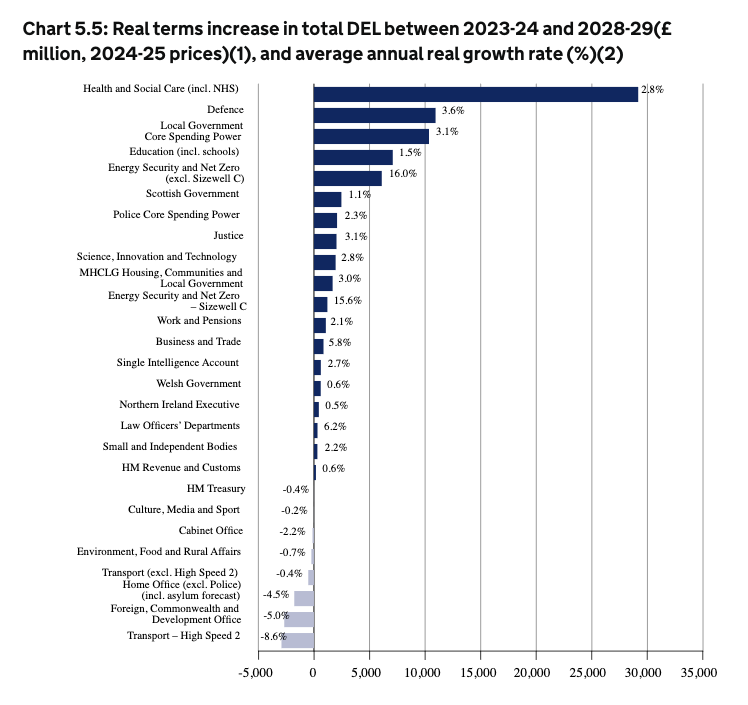
Overall, the DfE’s total budget will increase to £109.2 billion by 2028, “equivalent to an annual average real terms increase of 1.5 per cent”, the documents show.
That 1.5 per cent rise puts the DfE behind most other areas of spending.
For example, spending on energy security and net zero is rising by 16 per cent, the law officers’ departments are getting a 6.2 per cent boost and business and trade is getting 5.8 per cent.
However, it’s worth pointing out the DfE has a much larger overall budget than many other government departments. Just looking at cash amounts, education got the fourth highest increase of all departments.
But, according to the Treasury documents, the DfE’s administration budget will drop by 15 per cent over the spending review period to £490 million.