


HAVANA TIMES – The recent resignation of Cuba’s Minister of Labor and Social Security has brought the issue of social classes in Cuba to the forefront.
An Official Forced to Resign for Denying the Existence of Indigents
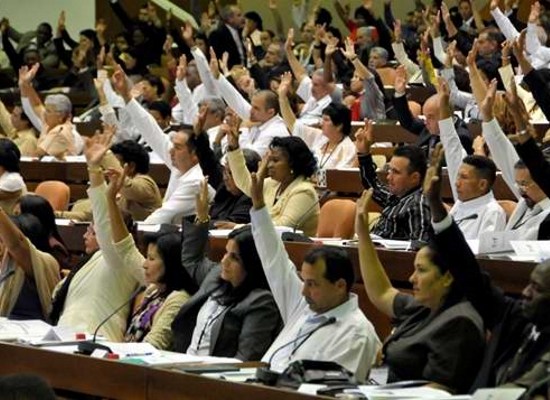
The minister resigned following a self-criticism requested of her at a meeting of the ruling party’s top leadership. The reason was a speech she gave before members of the National Assembly of People’s Power (parliament), who were meeting in committees, where she denied the existence of beggars in Cuba, claiming they were lazy people who didn’t want to work, and that their begging was a “disguise.” The speech was televised and immediately provoked a strong backlash on social media. Her resignation was then made public, after the aforementioned high-level meeting.
For me, the event goes beyond a monumental blunder by a top-level bureaucrat of the state nomenklatura, followed by her “cleansing” through self-criticism and “acknowledgment of errors,” courtesy of the ruling caucus of the Cuban establishment, which reserves for itself the “right” to act as the nation’s “moral judge” and society’s “vanguard.” Seen from any angle, it’s a matter of “us” versus “them.” And looking from below, it’s “them” who—through hate speech—are now making the issue clear.
If the former minister was not being hypocritical or lying (“Revolution means… never lying…” — Fidel Castro)—which is hard to believe, since there have been numerous official studies on poverty in Cuba for decades. During COVID, all “vagrants” were “collected”—then she simply confessed (as has been echoed in alternative media and social networks) to living in another reality, not ours, not Cuba’s reality.
If those in high places who reprimanded her for her “errors” are right—regardless of whether she was made a scapegoat for bigger issues—then they have acknowledged that the possibility of living off one’s labor, invoked by the former minister from within the “Cuban revolutionary ideology,” is nothing but a myth, a falsehood. And therefore, the entire ideology is false, since “social justice” based on work is its foundational pillar. In doing so, they also acknowledge the massive divide between the oligarchy and the population in survival mode, between leaders and the destitute, between them and us.
“Us” vs. “The People”
In any case, the ex-minister is not alone. Along with her are those who supposedly represent the Cuban people in parliament, who applauded her, supported her, or remained silent. As Cuban writer Enrique del Risco, who resides in the US, pointed out on Facebook, referring to such “representatives”: “If what the minister said was so unacceptable that she had to be dismissed the next day, why did no one question her when she said it?”
“Now let the parliament that agreed with her resign,” wrote Cuban LGBTIQ+ activist Maykel Vivero on Facebook. Just hours ago (proof that the case isn’t considered “closed”), mathematician and economist Dr. Javier Perez Capdevila, a tenured professor at the University of Guantanamo, asked on Facebook about the “disciplinary or legal” measures that were not applied to “deputies and officials who publicly supported” the minister, emphasizing:
“All quiet. All silent. Zero transparency. No one at the top says anything. The response to the people isn’t talk, it’s doing what’s right. Remember that the failure, or mistake, or disrespect to the people wasn’t only by the Minister of Labor and Social Security.”
The parliament’s internal agreement with what the minister said is nothing new; the National Assembly in Cuba is known for never straying from the Communist Party line and its top caucus.
On social media, pro-government journalist and former Cuban counterintelligence agent Manuel Orrio, and theater artist Iran Capote specifically called out the figure of deputy Yusuam Palacios, who spoke to the assembly immediately after the minister and praised her for achieving a “qualitative leap” in her speech on begging.
Palacios, a young intellectual promoted by the leadership, has worked for years in the “Martí Program,” overseen by the Ideological Department of the Communist Party of Cuba, which also controls the entire cultural sector, the media, and education content. Capote, along with other users, particularly pointed out Palacios’s inconsistency as a “Martí devotee,” since Jose Marti himself wanted, in his own words, to “cast his lot” “with the poor of the earth.”
With the minister’s outrageous remarks and the aftermath, the Cuban nomenklatura took off its mask. It fully revealed itself as an oligarchy detached from the rest of the people.
President Miguel Diaz-Canel later met with the parliamentary committee before which the minister had spoken and called her speech “counterproductive.” But aside from this damage control, this is the same Diaz-Canel who introduced the rhetorical framework separating “us” (i.e., the establishment) and “the people.” In the past, those in power wouldn’t dare speak that way. Today, they admit that it’s “us” versus “the people,” and no longer “we, the people.” In truth, they never were the people.
Zero “National Unity,” 100% Class Division
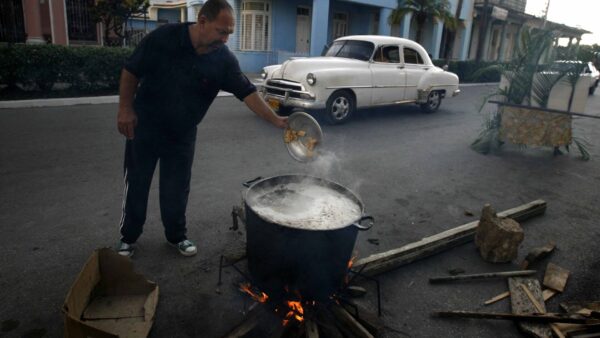
I talked with an elderly neighbor, cooking a stew over charcoal in a large pot during a blackout, and in the middle of our chat, he tells me: “I’m not speaking out against THIS; but what they’re doing is shameless now, the way they’re squeezing us.” The power outage had already lasted about twelve hours. “THIS” means the Revolution, “the process,” History, loyalty. “They” are the ones who misgovern and privilege themselves at our expense, squeezing the country dry. They are not us. Their reality is another one, it’s as if they don’t know how we live—but over here, we do know how they live. They are not THIS. We can be for THIS and against them. Because THIS is this here, our reality—not the one over there, where they live.
Even so, it’s as if THIS existed in the realm of the imaginary, while we, with our blackout and our pot, live in the real. In this way, the class conflict in Cuba today speaks from “the bottom of the pot.” Class struggle doesn’t arise from protests from below—it is born from the oppression and indifference of those above.
You walk the streets, listening to people, and you hear more and more about class conflict. The terms aren’t always used, but when someone precariously employed talks about leaders, small and medium businesses, luxury cars, managers, the millionaire, the business owner, about Sandro Castro (Fidel’s grandson living the high life) or the Machi (“first lady”), they are talking about THEM. And rarely is there affection or admiration in their words.
When Diaz-Canel assumed the presidency in 2019, the slogan “think like a country” was launched—an overtly nationalist, patriotic slogan intended to unify. It didn’t last long. Few noticed that during the pandemic, the word “Revolution” was barely used on Cuban national television. Only Dr. Duran, the head of epidemiology, mentioned it in his morning reports. He was also almost the only one who still talked about the Communist Party.
It seemed the plan was to subtly replace the term “Revolution” with something more palatable, more unifying, and less loaded. It worked for a few months during COVID lockdowns, and indeed, society did become more cohesive. But then they chose to initiate the wave of repression at the end of 2020. And the positive expectations never returned.
Five years later, the officials are ripping each other’s masks off, and the word “Revolution” is written on them—while behind, in hardened concrete, we glimpse the cloned face of a rapacious, homicidal Doppelgänger.