


Jagdeo backs non-oil economy to service Guyana’s ballooning debt if oil prices fall
Jul 25, 2025
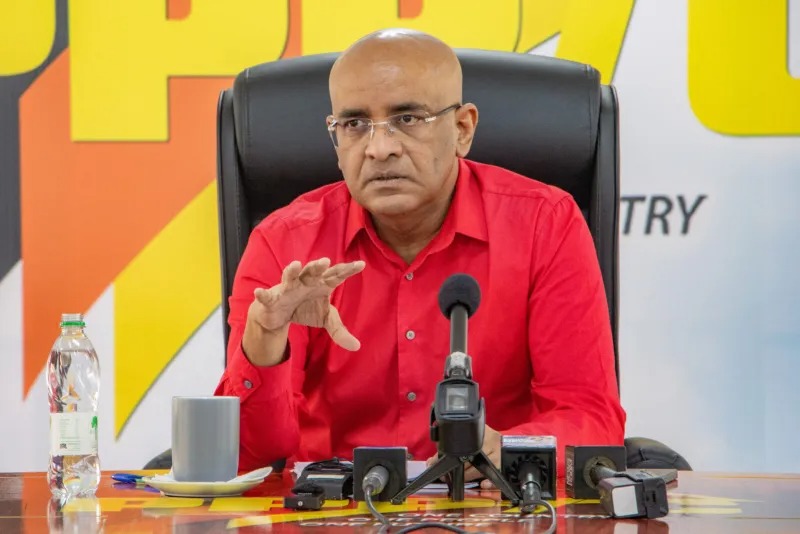
Vice President Bharrat Jagdeo
Kaieteur News – Days after giving no assurance that Guyana will borrow less in the future, Vice President (VP) Bharrat Jagdeo said he is confident that the country’s non-oil sector will service its ballooning debt if oil prices fall.
Responding to questions at his weekly party press conference on Thursday, Jagdeo said that Guyana’s non-oil economy has been growing over the years and he is confident that it has the capacity to pay the country’s revenue with the absence of an oil economy. “The only difference is that our debt to GDP ratio will increase”, the VP said.
Jagdeo is also the People’s Progressive Party/Civic’s General Secretary and at his weekly party press conference Kaieteur News asked him some questions on his government debt policy. One of the questions asked was, what explanation can he give to voters who are concerned that Guyana might be borrowing more than it is earning from the oil sector.
Kaieteur News pointed out that the country’s debt (US$6B-of which US$4.2 billion was added since 2019) is almost equivalent to the amount (A little over US$6B from profit oil and royalties) it has earned to date from the oil sector and that the government is also using that money (oil revenues) in addition to the loans to fund it infrastructural projects.
Jagdeo’s first response was that he “did get the point” that the media was questioning him on but acknowledged that Guyana is funding its 2025 U$6.63 billion budget with a combination of oil revenues, non-oil revenues and loans. “So if we say 37 percent of the budget comes from oil money so clearly it means that the rest have to come from somewhere else, so we pointed out that about another 30 something percent comes from revenue that is non-oil revenue right, so the rest comes from loans every year to fund the projects”, the VP said.
He said that borrowing is intended to support economic growth. “…So for example the Gas to Energy (project), the(US) EXIM bank (loan)” Jagdeo said while adding “Part of the bridge (the new Demerara Harbour Bridge) is funded from a loan, part from the budget, about 100 million US dollars from the budget (and ) and the rest is from a loan so it’s to build things okay.
Jagdeo then went on to defend his government’s continuous borrowing by saying the oil revenues alone cannot support the country’s entire budget at this time. “When people make these wild promises like APNU (opposition) and the others like Glenn Lall say we have so much oil money…you have to say these people are crazy, because the budget here which is to pay our public servants and do the capital works etc. even oil money can’t be enough to do that much less fund the big things”, he argued.
Jagdeo continued: “They are promising to give away this money so that in itself should show how sterile and basically uneducated those suggestions are because they are not sustainable.”
It should be noted that Businessman Glenn Lall’s argument is that if the oil projects are ring-fenced or the lop-sided Stabroek Block contract with ExxonMobil is renegotiated then Guyana will earn enough to pay off its debts and fund projects. Jagdeo’s government, however, has refused to renegotiate the contract or ring-fence any of the projects. Short-changed by the deal then the country will not be able to earn enough to fund projects and reduce its ballooning debt. Nevertheless, Jagdeo and is regime is hoping that with the approval of more oil projects, the country will earn more oil revenues in the future and only then Guyana might be able to stop borrowing.
In the second part of his response to Kaieteur News’ question he said “So we had outlined clearly we would have to continue borrowing into the future…so when we finish building the bridge say the bridge across the Demerara River and all the bridges to Lethem and the one across the river in Linden and all the highways most of which are already awarded. We don’t have to spend that money anymore right so then the capital budget shrinks,” he explained. Jagdeo said it is anticipated by 2027 government would not have any need to borrow “because we will be able to fund more of our activities from the budget, maybe 2027 2028 or so around that level,” he added.
Back in January 2023, the IDB had released a report cautioning Latin America and Caribbean (LAC) countries against ‘excessive’ borrowing and urged governments to bring their debts down to more prudent levels. In its report titled ‘Dealing with Debt – Less Risk for More Growth in the Latin America and the Caribbean’, the IDB disclosed at that time that debt has risen and stands at some US$5.8 trillion, which is 117 percent of the Gross Domestic Product (GDP) in the region. “Given the dangers of excessive debt, the current situation in Latin America and the Caribbean is worrisome,” the IDB said. IDB said public debt serves a critical role for countries to pursue public investment projects, implement counter-cyclical policies, and provide support to economies in the face of negative shocks. However, the IDB warned that if public debt becomes too large or is not managed with sufficient caution, interest costs may balloon, growth prospects may suffer, and in the limit, a costly debt crisis may be provoked. According to the report, governments can bring down their debt levels by improving spending efficiency, expanding the tax base, and seeking wider reforms to enhance fiscal balances and boost growth. The IDB said that there are many reasons why public debt levels should be lower than they currently are, highlighting that there are several ways to reduce that debt.
Related
Similar Articles