


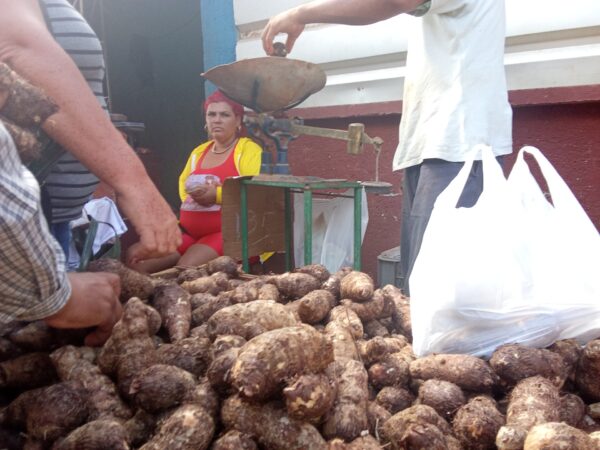
HAVANA TIMES – Many Cubans still remember the Roundtable TV shows that, at the end of 2020, Marino Murillo Jorge dedicated to calculating the generous budgets that—according to him—Cuban families would enjoy after the implementation of the Tarea Ordenamiento (Economic Overhaul Task).
This reform was presented as his crowning achievement after eleven years at the helm of the Ministry of Economy and Planning. But it raised doubts, particularly due to the decision to implement it during the COVID-19 pandemic.
Yet, the then–Deputy Prime Minister insisted on ignoring concerns and used heaps of statistics to explain how much the purchasing power of his fellow citizens would increase after the so-called “currency unification.”
“Even pensions are projected to cover daily needs and leave a surplus for savings and leisure. And that will improve as the economy reactivates thanks to the very decisions we’re making,” he declared in December 2020 before the National Assembly of People’s Power.
In the end, the scheme turned out to be an even greater failure than its harshest critics had predicted. The wages and pensions that were supposed to easily meet Cubans’ needs today often can’t even be withdrawn due to a lack of cash.
Lagging Behind Inflation
Just days ago, the government announced a pension increase for those receiving less than 4,000 pesos. The unexpected decision aimed to quell the outrage sparked by Minister of Labor and Social Security Marta Elena Feitó, who had claimed before parliament that “there are no beggars in Cuba.”
Many who beg or sell trinkets on the streets are retirees. In a country where independent economists estimate that a person needs between 7,000 and 10,000 pesos monthly just to eat modestly, 79% of pensioners receive checks under 4,000 pesos. Among them, a particularly vulnerable group stands out: the 438,000 retirees (26% of the total) who have for years tried to survive on the minimum pension, which until now was 1,528 pesos. Starting in September, they will receive 3,056 pesos per month.
(Note: One US dollar equals 390 pesos.)
The pension crisis is part of a broader income crisis affecting most Cubans. State workers (who make up 70% of the labor force) have the lowest and most insufficient salaries. This difficult and longstanding situation was made much worse by the Ordenamiento.
The best way to quantify the problem is by comparing inflation to income. Since 2021, the minimum wage has remained at the meager 2,100 pesos set by Murillo and his advisors when designing the Tarea Ordenamiento. The average salary, meanwhile, has shown a slightly better trend, rising 52% over the last four years, reaching 5,839 pesos per month at the end of 2024.
This figure is presented by authorities as evidence of success, conveniently omitting the fact that during the same period inflation rose at a rate three times faster. According to reports from the National Office of Statistics and Information (ONEI), cumulative inflation between 2021 and 2024 exceeded 173%.
And it may be considerably higher. Researchers like economist Pavel Vidal, a Cuban university professor now based in Colombia, have emphasized the need for ONEI to improve its methods of data collection and analysis. This could help avoid underreporting, as seems to be happening with the Consumer Price Index, the key statistic for calculating inflation. Considering that since 2021 the prices of all basic food items have increased by 15 to 40 times, it’s hard to understand how the officially acknowledged cumulative inflation isn’t higher.
The loss of purchasing power is also evident when converting incomes from national currency to US dollars, something they do to purchase in government stores that now only sell in USD. In 2020, the monthly minimum wage was equivalent to $16, and the average wage at $33.56. Five years later, the minimum wage buys just $5.38, and the average wage $14.97. And that’s using July’s average exchange rate (390 pesos per dollar), which will likely tilt even further in favor of the dollar in August.
The outlook is bleak even for workers in private businesses and foreign companies. Although wages in those sectors are significantly higher than in the public sector, most are still insufficient to keep pace with the rapid rise in the cost of living. Cases of employees at small and medium-sized enterprises (SMEs) or other private ventures holding multiple jobs used to be rare, but lately they’ve become common.
“The always-antagonistic relationship between wages and inflation has taken on dramatic tones in daily life. The upward trend in wages is quickly erased in the context of economic contraction and hyperinflation that has been bleeding Cuba dry for years,” reflected economic journalist Ariel Terrero this past April. The negative impacts of this situation are especially severe in knowledge industries and professional services, which are experiencing an exodus that already threatens the country’s development projects, he noted.
But the authorities have yet to find a strategy to escape the crisis. In practice, the government’s philosophy relies on emergency measures, which often do more harm than good. For example, wage and pension hikes by decree—implemented in the last year and a half for workers at the Electric Company and members of the veterans’ association—have translated into billions of nominal pesos entering circulation, without backing from the productive economy or even new money printing. There’s no data on the total cost of these measures, but we know that the recent pension hike alone will inject an additional 22 billion pesos per year.
Measures like these are exactly what should be avoided, warn researchers Karina Cruz Simón and Carlos Lage Codorniú of the Center for the Study of the Cuban Economy. “After more than three decades of depressed wages, adjusting labor incomes is unavoidable. However, a solution based on nominal increases will only fuel inflation and reduce real income, as already happened during the Ordenamiento.”
Instead of populist salary and pension hikes, logic would suggest directly delivering consumer goods to vulnerable groups. At the business level, this would mean unifying exchange rates and eliminating all bureaucratic barriers that hinder economic activity. But the first of these decisions carries a financial cost the government is trying to avoid at all costs. The likelihood of the second being implemented is also slim, since it would expose the extent of poverty on the island and further weaken the already shaky state monopoly over the economy.
Four years after the reform that was supposed to lift Cuba out of its systemic crisis, wages and pensions remain the country’s great unfinished business—one that fails the vast majority of household budgets month after month.