


Economist Pedro Monreal believes the government doesn’t care about hotels, but rather about the real estate business of leasing them.
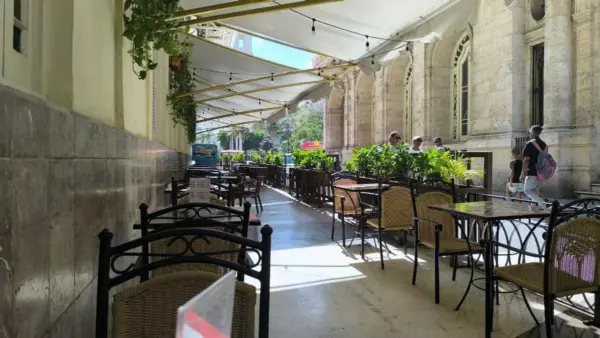
HAVANA TIMES – María, who had taken a break on her way to work, was the only customer this week seated on the terrace of the Inglaterra Hotel. “Look, there are the musicians, playing for no one, like every time I pass by,” she jokes while stirring her cappuccino, for which she paid 300 pesos to the waiter.
A scene unthinkable just years ago—when tourism was still one of the few thriving sectors on the Island—has now become commonplace in the new Cuba. Authorities no longer pretend to call it the engine of the economy and now admit that the current moment is the worst “since the collapse of the Twin Towers in 2001, not counting the pandemic period,” as the Minister of Tourism, Juan Carlos García Granda, stated last month before Parliament.
Two weeks later, Cubadebate published its own analysis of last year’s catastrophic tourism figures and sketched out a strategy to correct course, which, they believe, is to invest more. “Modernizing tourism infrastructure appears to be another unavoidable priority. Implementing targeted rehabilitation programs at key facilities—starting with the hubs in Varadero and the Keys—could significantly improve competitiveness without requiring massive investment,” the outlet noted.
These infrastructure improvements may include those the tourism minister announced for airports, but several paragraphs of the text also indicate planned hotel investments. “While Cuba struggles to maintain its hotel infrastructure, other countries in the region have invested massively in modernizing their offerings,” Cubadebate points out.
The data, however, shows that the Havana regime has done nothing but endlessly and inconsistently expand hotel capacity—regardless of the declining number of international visitors. Just this Friday, Cuban economist Pedro Monreal posted an article summarizing some alarming indicators—such as the case in Ciego de Ávila, where the number of accommodations quadrupled in just two years (2020–2022). In Holguín and Havana, hotel capacity also rose dramatically in 2024—by 26.3% and 28.4%, respectively.
“The scale of tourist arrivals did not warrant an expansion of lodging capacity during and after the pandemic. Increasing lodging capacity under conditions of sustained low occupancy ruins the operational efficiency of tourism,” the expert argues. His post analyzes other, more familiar data—like the fact that one-third of the country’s total investment has gone to the tourism sector, even though occupancy rates haven’t exceeded 30% in the past five years.
Monreal argues that the regime’s obsession lies not with hotels themselves, but in using them as investment vehicles within a real estate business model that benefits investment entities—in this case, the military conglomerate Gaesa, which leases its assets to international hotel management companies. This model, he claims, is “steadily subsidized by ‘extra’ investment funds (via the state budget) and by tax and customs advantages (derived from International Economic Associations).” There is little cause for optimism, he adds, since the system is “shielded by political favoritism and corporate opacity.”
The Cubadebate article, which naturally doesn’t mention this angle, states that the lack of tourists has been disastrous both for foreign currency income (down some $2.3 billion directly, and up to $8 billion if indirect effects are included) and for all related sectors. Contradicting ministers who told Parliament that travelers are staying away because of food shortages, Cubadebate offers something surprising:
“The farm sector, which allocates a significant portion of its production to supplying the tourism industry, now faces surpluses that have no alternative domestic market,” it claims—clearly at odds with both agricultural production figures and those of the manufacturing sector, not to mention the wishes of Cubans who would love to see those unexpected surpluses on market shelves. As if the state had even more to spare, the outlet also notes that “the transport sector, with a fleet of taxis and buses tied to tourism, is seeing its sustainability compromised.”
The article offers some unusual explanations for the collapse of tourism on the Island, which through June—at 1,680,304 visitors, 319,654 fewer than in 2024—had fallen by more than 20% compared to the previous year, which itself had not been a good one. Among the reasons cited (aside from the “US blockade”) are an allegedly adverse international context, worsened by inflation, a supposed recession in Europe (which does not exist), and rising airfare costs, all said to be hurting tourism globally.
Paradoxically, the World Tourism Organization has reported steady annual growth since the end of the pandemic, and forecasts for this year include growth of between 3% and 5%. Leading tourism nations, such as Spain, released positive figures on August 1 for the first quarter—for example, the Canary Islands exceeded 80% hotel occupancy—and expect August to see occupancy above 90% in areas like Andalusia, the Balearic Islands, and Catalonia.
Even Meliá, the Mallorca-based hotel group with major operations in Cuba, can debunk the supposed adverse international context. Its first-half financial results show that Cuba is precisely the weak point in its finances. The company earned 991.1 million euros, 3.2% more than in the same period last year, reduced its debt by over 28 million euros, and increased its net profit by 72.4%—all thanks to growth in every market except Germany and Cuba.
Cuba’s numbers at Melia run hotels are dire and, by far, the worst of all the major destinations: occupancy below 40% despite slashing prices—averaging 80 euros per night, 10% less than the previous year—and revenue per room at just 31.7 euros. Nevertheless, this July, Melia reopened the Hotel Bristol, previously operated by Kempinski.
Faced with this situation and the loss of many visitors from both its main market (Canada) and its biggest growth hope (Russia—whose decline is blamed on sanctions over the invasion of Ukraine, despite the sanctions having been in place for three years), the regime sees it as a positive sign that travelers from the US, thanks to the Cuban diaspora, have held relatively steady. It also notes that Mexico, Argentina, and Colombia remain strong, interpreting this as a sign of “successful promotional campaigns targeting South American audiences.”
First published in Spanish by 14ymedio and translated and posted in English by Havana Times.