


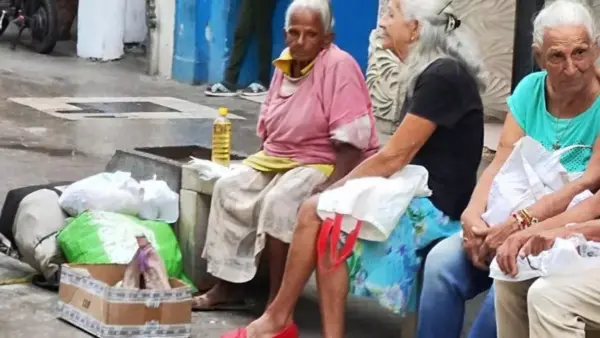
The increase in some pensions was approved on Wednesday and will take effect on September 1st.
By Juan Diego Rodríguez/Olea Gallardo (14ymedio)
HAVANA TIMES – One liter of oil, one kilogram of powdered milk, a pound and a half of pork… Cuban retirees don’t think in numbers when asked how much their pensions will go up — they think about what that money might buy in the well-stocked private businesses. That’s a common theme among those interviewed for this report, along with something else: they all believe the increase announced last month by Prime Minister Manuel Marrero won’t make much difference.
“Prices are so high that this increase is not significant when it comes to covering basic needs, especially food,” says Manuel, a 68-year-old retired employee of a state-run trade company, who will benefit from the measure. In his case, he currently receives 1,500 pesos ($3.85 USD), and starting September 1 — with payment at the end of August — his pension will rise to 3,000 ($ ($7.70 USD). “For me, that’s not much — maybe a bag of milk or a bottle of oil, and that’s it.”
Still, he considers himself lucky because his daughter sends him money from abroad. “Pensioners who have no other options, who are not healthy enough to find some work to supplement their income, or who don’t receive remittances, are doomed to go without.”
That’s the case for Dulce, a retiree from the Ministry of Culture. Her skepticism and frustration are overwhelming after months of waiting to receive cooking oil from the ration store. “There were no small bottles delivered for single-person households, and now I have to wait for several shipments to accumulate a full bottle so I can buy it,” she laments, adding sarcastically, “So that’s what I’ll use my increase for — buying oil at a private shop.”
According to the regulation, there will be an increase of 1,528 pesos for pensions up to 2,472 pesos, and pensions between 2,473 and 3,999 pesos will rise to 4,000. As for pensions due to death — such as widowhood or orphanhood — those will also increase and be “recalculated” based on the updated pension of the deceased, depending on the number of beneficiaries: 70% more if there is one, 85% if there are two, and 100% if there are three or more.
In addition, Benito Rey González, director general of the Ministry of Labor and Social Security, told state media that citizens entitled to more than one Social Security pension “will receive the increase on the amount of the unified pension.”
“Even if they raise it to 4,000 pesos, or 5,000, or 6,000, or 7,000,” protests Olivia, a retired Education Ministry worker, “none of that is enough for someone who worked 30 or 40 years to get by.” What particularly angers her is the attempt to portray this as an achievement. “In every other country in the world, that money comes out of your paycheck every month — that’s why they deduct it — and also from taxes paid by other workers. It’s not a gift from the State.”
Despite 37 years of uninterrupted work, Olivia tells 14ymedio, she ended up with a minimum pension. “They raised it a little the first time, and then another little bit — to 1,500 pesos,” she says. And she adds with resignation: “Well, the law is the law. You have to accept it, because everything they tell you, you have to accept. What can you do? Where can you complain? But I really don’t think this will solve anything, when a pound of milk costs 1,200 or 1,300 pesos. It’s just a way to shut us up amid all the hunger and misery the elderly are experiencing in this country.”
María’s pension increase — she currently receives 1,400 pesos — will be enjoyed by a friend of hers: a resident of the United States who prefers to have it collected in Havana, “where people are really struggling.” It’s a common situation: retirees who no longer live in Cuba but continue to collect their pensions through third parties.
In a context of extreme poverty, solidarity between citizens becomes the last resort. Tania, a resident of Central Havana, says she helps her 96-year-old neighbor, who receives 300 pesos less than she does — just 1,200. “I’m not someone who goes to church and gives a tithe. I try to help people who come to me because I know they’ll make good use of it and they need it,” she explains. “When I heard about the increase, I was happier for her than for myself. She’s an elderly person, very sweet, very polite, from a good family, but she worked very little, in a kitchen, and was left with the minimum.”
The elderly woman lives with her two daughters, who also receive the minimum pension. Not only are they evidence of the hardships suffered by those over 60 in Cuba, but they also highlight one of the country’s main problems: population aging.
Leonardo, a former police officer, won’t receive any increase because he already gets 4,000 pesos ($10.25 USD). “After 26 years of service and losing my eyesight,” he says. Disappointed, he approached a colleague at the Ministry of the Interior who told him: “They’re looking into maybe giving a little increase in December.”
First published in Spanish by 14ymedio and translated and posted in English by Havana Times.