


Belize, Mexico and Guatemala create 2nd largest biodiversity corridor in the Americas
CALAKMUL, CAMPECHE, Mexico, Mon. Aug. 18, 2025
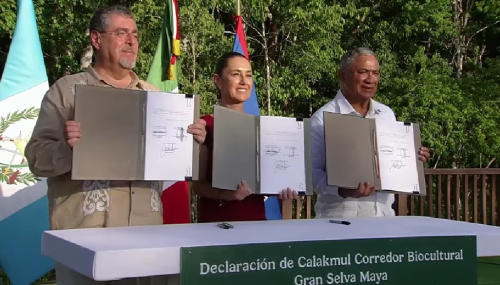
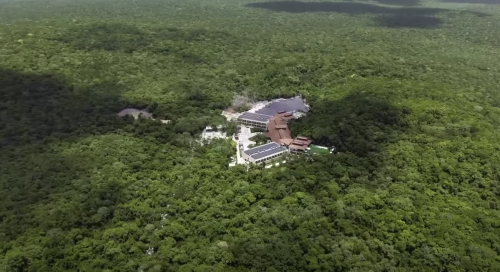
Prime Minister John Briceño, accompanied by a small delegation of Cabinet Ministers and CEOs, travelled by Astrum helicopter to Calakmul, Campeche, Mexico on Friday, August 15 for a historic trilateral meeting with Mexican President Dr. Claudia Sheinbaum Pardo and Guatemalan President Bernardo Arévalo. The heads of government of the three states had never met jointly before. Following the trilateral talks, there was an open-air press conference at the luxury 144-room Hotel Mundo Maya Calakmul, where the three leaders delivered brief statements then signed the landmark Declaration of Calakmul for the establishment of a biosphere corridor to be called the Great Maya Rainforest of Belize, Guatemala and Mexico. The bio-cultural space, spanning 22,008 square miles, would rank second only to the Amazon Basin, which stretches across nine countries and covers approximately 2.72 million square miles.
While the press conference after the trilateral meeting centered around that one topic, once Belize media, on Tuesday, got wind of the upcoming meeting, the Government of Belize Press Office Thursday revealed via press release that the three leaders would discuss the Tren Maya, energy, migration, security, the environment, agriculture, investment, infrastructure and air connectivity.
In the case of the Belize-Mexico bilateral meeting, in her Friday morning briefing before departing to Flores, Petén to meet Arévalo, Sheinbaum stated, “With Belize, there are also projects related to the interconnection of the Maya Train, which they’re interested in, along with other proposals they’re putting forward—issues related to security, and, above all, environmental matters, which I won’t get ahead of since they’ll be announced later.” That bilateral meeting started after 5:30 p.m. on Friday, once the trilateral press conference had concluded, and we are told that the Ministry of Foreign Affairs is preparing a statement on the outcomes. Foreign Minister, Francis Fonseca wrote on his Facebook page on Sunday that the bilateral discussions were very productive.
With Guatemala, discussions centered on security and migration as well as development cooperation projects which include two train projects (the Tren Maya and the Interoceanic Train, both of which are now expected to be extended to Guatemala), energy development, and a project for a hub of well-being for economic development along the Chiapas-Guatemala border. In the joint press conference that followed the Mexico-Guatemala bilateral talks, Arévalo revealed that the two countries agreed to draft a bilateral repatriation protocol for immigrants and to implement a temporary bilateral labour program that promotes safe and dignified labour migration.
PM says Tren Maya discussions still preliminary
On his arrival at the venue for the trilateral meeting, PM Briceño fielded questions from the media, revealing for the first time that “the idea with Tren Maya is that it will follow the highway.” However, he was quick to emphasize that discussions about expanding the Maya Train to Belize remain in the early stages.
Responding to reports that the United States harbours suspicions about Chinese involvement in financing the Tren Maya, the PM responded, “Well, if the Americans are prepared to put in the money, they are welcome to do so…we’d be happy to get the assistance from them.” When asked whether this could potentially strain the relationship with Taiwan, the PM simply reiterated Belize’s continued support of Taiwan.
We note that in Trump’s first term, in 2019, the Associated Press had cited then Mexican president, Andrés Manuel López Obrador (AMLO) as saying that the U.S. government had offered to help finance the Tren Maya (see: https://apnews.com/32e2353fc6424bb9becf021da67c0cf2).
Mexico offering to connect two trains to Guatemala
President Claudia Sheinbaum, a close ally and protégé of AMLO, is advancing his peaceful “Fourth Transformation,” a political project intended to usher in a new era in Mexico’s governance, on par with the War of Independence, La Reforma and the Mexican Revolution. The ideological initiative seeks to eradicate corruption, restore public trust in institutions, expand social programs, revive national industries and enforce austerity in government spending. Infrastructure is a strategic priority of the Fourth Transformation, with several major projects underway, including the second railway project apart from the Tren Maya: the Interoceanic Train. Plans are in motion to expand it into Guatemala via the Pacific corridor connecting Tecún Umán and Ciudad Hidalgo in Chiapas. This train will run from Oaxaca to Veracruz, cutting across the Isthmus of Tehuantepec.
President Sheinbaum on Friday reported that the train has two lines that are nearing completion. One, the southern route, stretches from Oaxaca to Ciudad Hidalgo. She added that the goal is to link Tren Maya with the Interoceanic Train.
Construction for Tren Maya’s freight line begins this year
At the joint Mexico-Guatemala press conference, President Sheinbaum also announced that construction for the freight line of the Tren Maya is set to begin this year. “Currently, it’s a passenger train,” she remarked. She shared that the freight train will allow Mexico to connect the north and south by rail using the “long forgotten” trains in the country.
Regarding the proposed expansion of the Maya Train into Guatemala and Belize, Arévalo announced that trilateral negotiations will be initiated, alongside the corresponding feasibility studies. “This project, this railway interconnection, holds enormous potential for trade between our two countries, for development and well-being in Guatemala and southern Mexico, and for the entire Mesoamerican region.”
Speaking broadly about the motivation behind the regional collaboration and the shared benefits of extending Tren Maya to reach Guatemala, Dr. Sheinbaum stated, “It’s a different vision of cooperation for development. For us, human mobility—migration—must be addressed at its root causes. People in general don’t migrate by choice; they migrate out of necessity.”
Despite reports of huge financial losses in its first months of operations, according to Sheinbaum, “The Maya Train is a success in Mexico. So far, more than one and a half million people have used it.” She called it a strategic project that brings visibility to Mexico’s south “where historically, development was only envisioned in the north.” Describing the project, she stated, “It channels tourism from the northern part of Quintana Roo – Cancún and its surrounding areas – to the rest of the peninsula. Incorporated are the states of Quintana Roo, Chiapas, Campeche, Tabasco, and Yucatán. Associated with the Maya Train are several ‘Maya World’ hotels …” One such hotel was the Hotel Mundo Maya Calakmul where the trilateral meeting was held. The hotel is located less than 7 miles from the archaeological site of Calakmul, one of the most significant Maya capitals in the region, with a history spanning over 12 centuries. The site is located within the Calakmul Biosphere Reserve which covers 2,792 square miles and was designated by UNESCO as a Mixed World Heritage Site in 2014.
Newly established biodiversity corridor includes 11 of Belize’s protected areas
The aim of the Great Maya Rainforest initiative is to foster a model of sustainable development that would benefit over 2 million people. At the same time, the leaders of Belize, Mexico and Guatemala pledged to respect their culture and to learn from their ancestral practices. Prime Minister John Briceño, in his brief remarks at the signing ceremony on Friday stated, “… we are not only protecting an invaluable ecosystem, but also honouring the legacy of the civilization that once flourished in these lands. Mexico, Guatemala, and Belize once again demonstrate that our political borders do not divide us, they unite our efforts to preserve one of the planet’s last remaining lungs and the living heritage of the Maya peoples.”
Describing the size of the area, Sheinbaum stated, “We’re talking about 0.6 million hectares [2,316.6 square miles] in the case of Belize, 2.7 million hectares [10,425 square miles] in the case of Guatemala, and of 2.4 million hectares [9,266 square miles] in México.”
President Arévalo provided details of the design and implementation of the initiative, sharing that there will be a Council of Protected Areas Authorities, comprising representatives appointed by the three countries. Additionally, they will incorporate environmental organizations, the business sector, academia, and civil society through a Trinational Support Group. They cited shared threats to be confronted as: illegal logging, wildlife trafficking, non-authorized infrastructure, forest fires, environmental pollution and poaching.
On a related note, President Sheinbaum announced at the joint press conference in Calakmul that Mexico will begin the second phase of its agricultural program, Sembrando Vida with continued assistance for Belize and Guatemala.