


SPTC’s science advisor: “It’s just too much sargassum, and it’s all over the place, and it’s still very uncontrollable.”

SAN PEDRO, Ambergris Caye, Thurs. Aug. 28, 2025
Efforts to address this year’s intense sargassum invasion are taking a financial toll on affected local governments and tourism businesses, but it is also negatively impacting the workers tasked with its arduous removal. Today, we examine an initiative by the San Pedro Town Council (SPTC) in Belize’s premier tourist destination, Ambergris Caye. The Council has managed to keep approximately one mile of beachfront free of sargassum in what they refer to as the town core.
Valentine Rosado, a biodiversity scientist retained as the Mayor’s science advisor, is spearheading the ongoing sargassum clean-up effort. He reported that the influx has remained consistent since February, and unlike previous years when they would get a few weeks of respite, this year, that window has shrunk to just three days at most. As to how the work is done, Rosado stated, “We’ve looked at all the options that people talk about: big machinery, suction systems, helicopters …” However, his conclusion is that the best option are the small pick-up trucks, as the solution has to be feasible, especially when factoring in weekly maintenance costs and the tonnage of sargassum being removed.
For the one-mile stretch of beach being kept free of sargassum, Rosado says the operation employs 20 to 30 workers on one shift. That includes truck drivers, heavy equipment operators, and beach workers who clock in at 6:00 a.m. and finish by 2:00 p.m., five days a week. The estimated weekly cost provided by Rosado just to maintain that one mile ranges from $40,000 to $50,000. He notes that this figure represents only about 40% of the resources actually needed to properly sustain the effort. During the week of August 11, Rosado says they extracted 190 tons of sargassum from the town core.
According to Rosado, some resorts are conducting their own daily clean-up operations along their beachfronts, employing three shifts and spending between $20,000 and $30,000 weekly to sustain their efforts.
A major concern is that Ambergris Caye spans over 25 miles, and large portions of its coastline remain untouched by clean-up efforts. As a result, the sargassum dries up into dark, compacted mats that stretch along the beach and extend hundreds of feet into the sea. “It kinda looks like land,” remarked Elito Arceo, tour operator and President of the Ambergris Caye Citizens for Sustainable Development (ACCSD). He and other observers have noted that the build-up causes water discoloration and creates pockets of warmer water. This is apart from the stench that hangs over the shoreline from the rotting macro algae.
The fishing industry is expected to suffer significant impact, too, as the sargassum crisis deepens. Arceo, an avid fisherman, described the current conditions stating, “You can travel for miles outside the reef and all you will see in every direction you can pass or see, are sargassum – and some of them are maybe the size of a football field. You just see it coming!”
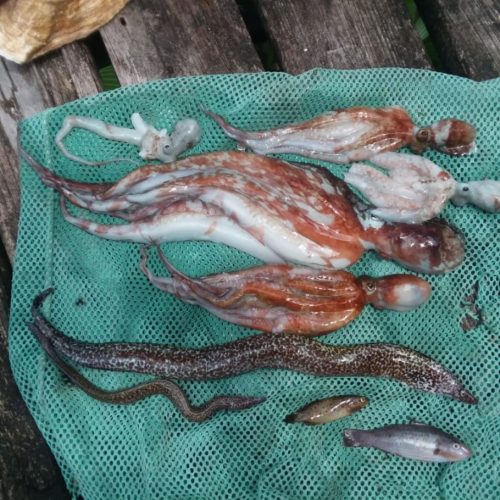
Last week, a marine biologist documented a troubling die-off of marine life near the reef. He photographed a wide range of juvenile species floating in the water. They included sardines, bonefish, octopus, urchins, snapper and others. “There’s everything dying,” said Arceo. The marine biologist also reported seeing signs of coral bleaching and Arceo attributes this in part to sargassum. “The brown water, the discoloration is actually on top of the corals and in the reef in some areas,” he reported. This is occurring in the areas where the reef is closer to the shore and so the sargassum stretches all the way to the corals. “The species living in the coral reef are dying,” shared Rosado. He called the situation unprecedented and says they don’t have to wait for secondary effects as the impact on the reef is immediate. Arceo says this is expected to have a long term effect on the fishing industry, as “the babies are dying.”
Rosado explained that as sargassum decomposes, it depletes oxygen levels in the water, killing off marine species that inhabit the shallow coastal zones.
Traditionally, people have used sargassum for landfill. The Town Council previously distributed it to residents across the island but has since shifted to depositing it in a central location. At present, only one vehicle is dedicated exclusively to sargassum removal, while other trucks and tractors are taken out of rotation from the garbage collection duties. However, the constant exposure to salt water takes a toll on the equipment as does the large tonnage being moved. “The shovels only last about 6 months, the wheelbarrows – they only last about 2 months …,” reported Rosado.
A similar toll is being reported on metal objects along the coast and the blame is being ascribed to sargassum. Rosado explained, “When it begins to decay you have different gases, hydrogen sulphide being the main one, right? And this is what smells and this is in the air. It affects everything. Televisions are the first to go. ACs. The motherboard from ACs. If you have watches, gold ring, earrings. All those things change color.” He also reported health issues among beach workers who suffer from sinus, allergies and eye and throat problems as well as rashes “because they have to sit and smell this all day for days at a time.” As for long-term effects, he says those are not being studied, and highlighted the importance of removing sargassum when it is still fresh, as the problems begin once decomposition starts.
Asked whether tourists are citing sargassum as a reason for cancelling their trips to Belize, Arceo said they don’t have direct reports from hotels, but on social media they see posts from visitors who say they cut their trip short. He noted that it has gotten so bad that at Mexico Rocks, which is a popular snorkelling site, some of the corals were not even visible last week. Tour operators had to divert to other locations.
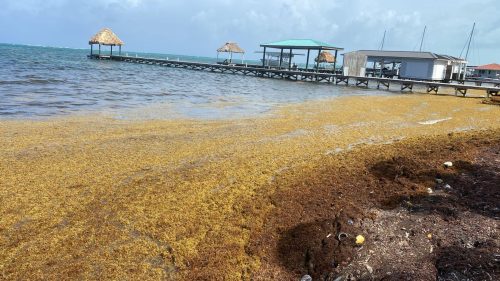
“We need to do more,” Rosado emphasized while revealing that their resources are stretched to the limit. He said they are awaiting the declaration of the sargassum invasion as a national emergency, something the Prime Minister has indicated is under consideration.
In the meantime, the Belize Fund for a Sustainable Future today announced that it is making $250,000 available to communities hardest hit by sargassum, particularly those not yet working with any local government on clean-up efforts. The Belize Fund has partnered with the Belize Hotel Association and the Belize Tourism Industry Association to vet the applications.