


By William Ysaguirre (Freelance Writer)
SAN PEDRO TOWN, Ambergris Caye, Thurs. Sept. 4, 2025
The government of Belize signed agreements for foreign direct investments totaling US$35 million on the first day of the 3rd Investment Summit 2025 being hosted by the Ministries of Finance, Economic Transformation, Trade and Tourism at the Grand Caribe Resort in San Pedro Town from Wednesday through Friday, September 3-5. Investors at the summit were invited to partner in Belize’s economic transformation, capitalizing on its natural wealth and workers’ skills.
Prime Minister Hon. John Briceño and Minister of Economic Transformation Hon. Osmond Martinez, PhD signed a Memorandum of Understanding with Jose Rodriguez, the founder of Santander Group, and chief executive officer Jonathan Taylor of Sucro Ltd., an integrated U.S. and Canadian sugar refiner and distributor, who will partner with Santander Sugar Ltd. of Belize in a joint venture, the Caribbean Sugar Refinery Limited (CSR). CSR proposes to build a US$20 million modern sugar refinery within the Santander Sugar mill complex in the Valley of Peace, Cayo District, which is targeted to begin operations next year.
The Sucro refinery will focus on supplying CARICOM’s needs for refined sugar, as it will be able to meet up to 75 percent of CSME’s demand. Sucro also announced plans to further expand to Trinidad and Tobago, when it would be able to supply up to 150 percent of the region’s demand for refined sugar, and they would aim to export to North America and Europe. CSR is committed to environmental sustainability by adhering to the company’s Environmental Compliance Plan (ECP) and the industry’s best practices.
For its part, the government will provide the enabling environment for the new refinery to acquire raw sugar for refining, and engage with our CARICOM neighbors to penetrate the CSME market. Santander will manage and operate the refinery, overseeing logistics and procurement to ensure that they align with the Belizean sugar sector and communities involved in the industry. The project is expected to create many new jobs and indirect employment in Belize and across the region, promoting regional trade, and providing a stable market for the region’s sugar producers.
Prime Minister Briceño also signed a US$7 million loan agreement with Tomás Bermudez, the general manager of the Inter-American Bank for Central America, Mexico, Panama and the Dominican Republic, to support a program to improve labor force participation and employability in Belize. The objective is to enhance the supply of skilled labor in Belize. The specific service is to improve access to skills training for the general labor force population, while providing specialized support, especially among women, youths and migrants, increasing skills supplies through relevant and quality-focused training in priority sectors. The US$7 million loan will come from the IDB’s ordinary capital, along with a further US$1 million non-reimbursable grant. The program will be jointly co-financed with a US$7 million loan from Taiwan’s International Cooperation Development Fund (ICDF).

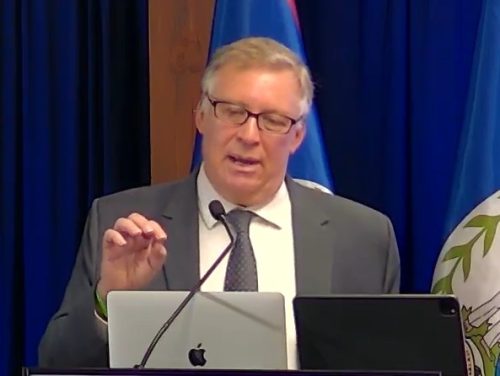
Belize should explore the possibility to export more to Mexico, which is a huge market of over 131 million, whereas Belize currently exports almost 4 times more to our neighbor, Guatemala, which is a much smaller market of 19 million inhabitants, recommended guest speaker Professor Ernesto Stein PhD of the Monterrey Technology University, a former IDB representative for Mexico. Beef on the hoof – cattle—accounts for 60 percent of Belize’s exports to Mexico, and soybean meal is 20 percent; but Belize has a competitive advantage with 20 other products that it should seek to export in larger amounts to Mexico. These include sugar and candy, fish, lobster, shrimp, and conchs, processed products of vegetables, fruits or nuts, food residues – cereals and starches, as well as tobacco, vegetables, processed meats and fish products, flour, starches, and malts, wood, dairy products, cereals – sorghum, as well as essential oils from citrus products. Only 1.9 percent of Belize’s exports went to Mexico in 2023, compared to 19.87 percent to the USA, and 16.56 percent to the United Kingdom, which are much farther away
The United States’ protectionist policies under President Trump, particularly new tariffs, have created opportunities for Belize, which now has a competitive edge, as Belizean exporters pay only 10 percent tariffs to enter the U.S., while most other countries who export to the U.S. now pay higher tariffs of 15 – 30 percent; and they are farther away, so it costs more to ship those countries’ products to the U.S. Stein noted that Belize also has a potential to expand in agro-processing to produce value-added food products: sauces, preserves, jams, canned products to replace imports, which can then easily be scaled up for an export market, in Mexico right next door!
Belize earns 75 percent of its export revenue from services – with 54.54 percent from tourism and travel, and 20 percent financial services and Business Process Outsourcing (BPO), so Stein suggested that Belize should seek to expand its BPO sector, where it has a significant advantage. Belize’s BPO sector has grown from one call center in 2005, to 20 BPOs in 2025, which together employ 16,000 workers. Belize’s BPOs have a competitive advantage in that the population is English-speaking, resulting in seamless communication with U.S. clients, and more than 50 percent are fluent in English and Spanish. Wages are very competitive, and BPOs have a higher retention rate of workers than BPOs in other countries. Belize has advanced telecommunications fiber-optic infrastructure, and the government offers investment incentives and a business-friendly environment. Belize’s time zone aligns well with the USA market. Continuous growth in the BPO sector will require investment to enhance the agents’ skills, in order to provide specialized services: in technical support, AI, cloud computing, cybersecurity, data analytics and web development, etc.
Belize has upgraded its tourism sales slogan from “Mother Nature’s best kept secret”, to “Mother Nature Overload”. Branding the Belize tourism product is key to competitiveness, advised guest speaker Adam Stewart, executive chairman of Sandals Resorts International. Belize wants to keep its name in the forefront of the minds of its target customers in high value markets like the USA, Canada the U.K. and EU, but it is also competing with Disney World, France and Japan, which all have well-funded marketing campaigns to promote their brands. Sandals began in Jamaica in 1981, and now operates 24 resorts across 11 Caribbean islands, employing 20,000 workers, of whom 97 percent are CARICOM nationals. Stewart explained that this success is built on the brand, which has won every award for excellence of the hospitality service with which the Sandals name has become synonymous.
Sandals is also constantly investing to enhance the skills of its workers, investing $5 million to establish the Sandals University, so that its workers may earn their professional university degrees, paid for by the company, while they work, Stewart explained. Sandals’ business model is based on the belief that “mass follows class”. Belize’s English-speaking workforce makes it an attractive destination for the lucrative USA, Canadian, U.K. and E.U. markets, and the workers’ training program funded by the IDB US$7 million loan and the ICDF US$7 million loan fit in well with this advice.