


By William Ysaguirre (Freelance Writer)
BELIZE CITY, Thurs. Sept. 18, 2025
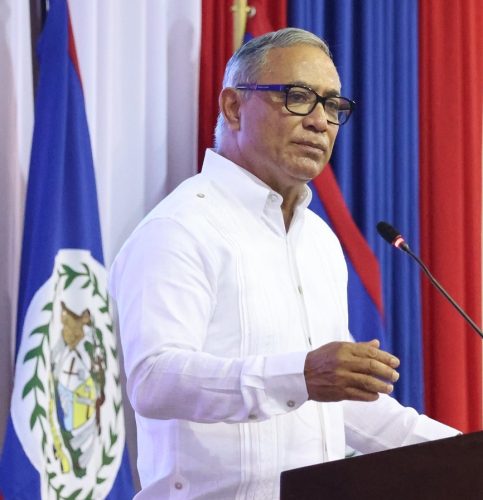
In his State of the Nation address at the University of Belize gymnasium on Tuesday, September 16, Prime Minister Hon. John Briceño said that the government’s Plan Belize 2.0 is being implemented at a brisk pace, with $140 million in new investments in power generation, a proposed $800 million cruise port development, and $170 million invested over the past 3 years in agro-processing of new value-added food products, which grew the Belize economy by 8.1 percent in 2024, according to the International Monetary Fund report card. The Prime Minister proudly proclaimed that unemployment fell to less than 5 percent, with widespread reports of worker shortages, as employers seek to hire workers, rather than workers looking for jobs.
His words were preceded by the awards of citizenship to 44 new Belizeans of diverse ethnicity, culture, and countries of origin, who pledged loyalty and life to Belize. The Prime Minister noted that their right to a dignified living had been enhanced by the Government raising the minimum wage to $5.00 per hour, which will put millions of dollars in the pockets of hard-working Belizeans, and he promised that the government will work to raise the minimum wage to $6.00 an hour. He cited the 15,000 public officers, teachers and security personnel who will earn an additional $100 million as a result of the Government’s recent agreements with the labour unions.
PM Briceño also noted that new currency notes that entered circulation last month, with the faces of our national heroes, George Price and Phillip Goldson, replacing the deceased monarch, have not lost their value peg since 1949, backed by rock solid reserves.
He further stated that tourism accounted for much of that economic growth, as the industry generates over 40 percent of Belize’s foreign exchange, and with a 1.3 percent increase in overnight visitors to 364,418 through July this year, and a 5.3 percent increase in cruise passengers to 595,682, the government feels the time is ripe to develop the Port of Belize into a cruise port capable of berthing 4 Oasis-class cruise ships, and to enhance its cargo facility, an investment expected to surpass $800 million by the time the project is completed. This would require dredging the existing channel through the reef to a 12-meter depth, allowing larger container ships to dock, thus achieving economies of scale that would lower freight shipping rates per tonne and make the port attractive to facilitate our neighbors’ imports, which would be amplified if Mexico’s Tren May project reaches Belize City.
Belize is also expanding airlift capacity with Air Canada’s new service from Montreal, and Spirit out of Fort Lauderdale adding a low-cost option later this year. The Philip Goldson International Airport is also improving its terminal building, the apron and parking facilities. Investments in hotel expansion have added an estimated 621 new rooms this year.
Hon. Briceño said that all these new developments will require electricity, for which the Belize Electricity Limited (BEL) signed a power purchase agreement on July 10 with the Blair Athol Power Company Limited (BAPCoL) for 15 Megawatts of solar power generation. BEL projects to add 80 megawatts more of solar power, to come online in 2026, by signing 4 more agreements before the end of the year, which together will represent a $140 million investment.
In Prime Minister Briceno’s address, he also commented that agriculture was the mainstay of the economy before tourism, and is also growing, with $170 million invested over the past 3 years in value-added products to replace imports, with the surplus being exported to the region. These include $60 million invested in new plants for coconut water and coconut oil processing, juice processing, fruit pulp processing, soursop and pineapple processing, and the preparation of fresh coconut for export. Coconut production has expanded, with 18,000 acres planted in new trees yielding just over 22 containers of coconut water and 700,000 nuts exported up to the end of July, which is expected to generate $4 million in 2025; and these export earnings are expected to double in 2026, when recently planted fields begin to produce, and the farmers begin to export green nuts to Mexico.
Over $50 million was invested in two new flour mills, processing wheat flour into ramen, and a corn meal plant to make corn chips and snacks, said PM Briceno, and another $32 million has been invested in a soybean meal, oil and animal feed meal plant and a soybean oil refinery.
Poultry farmers have also invested $23.2 million to expand and upgrade their processing plant for new value-added products such as chicken ham, chicken sausages, and bologna sausages. The dairy farmers invested $6.8 million in a Ultra High Temperature milk processing and dairy plant to produce long-shelf-life packaged milk. Cacao producers invested almost $5 million in chocolate manufacturing. Additionally, government’s investment incentives and the opening up of new export markets in Mexico and Guatemala have encouraged farmers to invest in increasing their corn, soybean, sorghum, coconut, cacao and non-tropical fruit production, and to expand their cattle and poultry products, Hon. Briceno said. Shrimp farms and other marine fisheries have also stepped up production. These investments partly offset the crisis in the sugar industry, which was a mainstay of the economy when the COVID pandemic shut down tourism. The devastating fusarium disease cut sugar cane production by 15.47 percent and raw sugar production fell by 23.9 percent as a result, said the Prime Minister, but the government is working to come to the farmers’ aid. SIRDI (Sugar Industry Research & Development) invested $500,000 in an experimental pilot project to treat 2,500 acres of cane field with fungicide, which proved effective, and Cabinet recently approved $2.5 million to rehabilitate over 6,000 acres of cane fields. The Ministry of Economic Transformation has raised another $7 million from the Climate Resilient and Sustainable Agriculture Project (CRESAP) funded by the World Bank, $1.5 million dollars from the Green Climate Fund through the CARICOM Climate Change Center (5C’s), and $7 million from the Development Finance Corporation (DFC) for on-lending to the farmers to help them rehabilitate another 35,000 acres. Prime Minister Briceño said that he remains optimistic that the cane farmers will defeat fusarium, just as the cattle ranchers will overcome the New World Screwworm challenge.