


Foreign Minister Fonseca says Belize will accept no more than 10 transferees per year
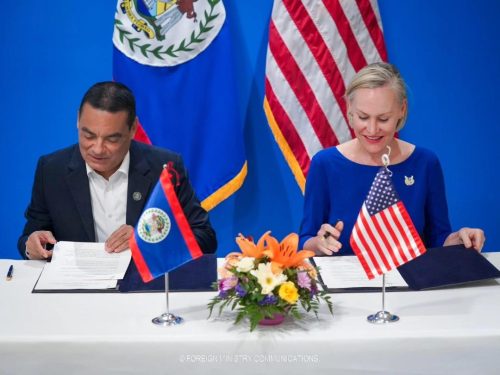
BELIZE CITY, Fri. Oct. 24, 2025
As recently as January 8, 2025, just weeks before the March 12 general elections, Prime Minister John Briceño publicly rejected the idea of Belize becoming a safe third country for the United States. The question was posed in light of President Donald Trump’s immigration agenda and his push for safe third-country agreements across the region. Such agreements require host nations to shelter migrants while their asylum requests to the U.S. are processed. PM Briceño was unequivocal: “No, we will not accept it.” Pressed further on whether Belize might yield under pressure from the U.S., Briceño responded, “We are a sovereign nation, and they cannot force us to accept people that are not citizens of this country; and as far as I am concerned, we are not going to accept any citizen that is not Belizean.”
Fast forward to Monday, October 20, 2025, and Belize’s Minister of Foreign Affairs, Hon. Francis Fonseca signed a safe third-country agreement on behalf of Belize, with U.S. Chargé d’Affaires, Katharine Beamer signing on behalf of the United States government. It did not come as a surprise, as Belize Government officials had already admitted back in July of this year that the U.S. had asked Belize to accept becoming a safe third country. It was the second time the request was being made to Belize. The first time was in 2019 during Trump’s first administration.
In early September, Prime Minister Briceño revealed that negotiations were underway with the U.S. for the signing of an agreement. He also disclosed that by that time, the subject had already been discussed in Cabinet, which had granted approval for talks to proceed. PM Briceño emphasized that Belize would retain full control over the number of migrants accepted and their countries of origin. He assured it would not be a large number. He also indicated that the U.S. would provide funding “to allow these people to be able to settle into Belize while their case goes through the U.S. courts.”
At the House of Representatives meeting on October 17, in a statement by ministers, Foreign Minister (FM) Hon. Francis Fonseca revealed that the Government was finalizing the agreement formally known as the Agreement for Cooperation Regarding the Examination of Protection Requests. Providing some context, he explained that such agreements are often misunderstood, and added that they are grounded in the 1951 U.N. Refugee Convention, offering a framework for cooperation to manage migrants who require protection and resettlement. In Belize’s case, he remarked that we have a long and proud tradition of effective management of an asylum system that meets our international obligations. He then delved into the safeguards that Belize requested. They include: “an unqualified veto over who is transferred to Belize, restrictions on the nationalities that could be transferred, a cap on the total transferees per annum, consideration of criminal records and professional skills.” He notified that the agreement would be for two years in the first instance, and that either party could terminate the agreement via notice in writing. He added that the agreement provides for financial and technical support on request.
Fonseca affirmed that the agreement will only come into effect once it has been ratified by the Senate. Additionally, before operationalization, relevant legislation must be amended, including the Refugees Act. Thereafter, the parties must draft an implementation plan and operating procedures. Fonseca added, “And then, only if necessary will the agreement even be used.”
Upon the signing of the agreement, the Government of Belize issued a statement providing additional information, stating that there would be comprehensive security screenings for migrants, and that “No person who is deemed to be a threat to the public safety or national security will be allowed to enter or stay in Belize.”
At a press conference of Opposition parliamentarians on October 23, Opposition Leader, Hon. Tracy Panton warned that the agreement “by its very nature, can reshape Belize’s immigration and asylum systems and impose new financial burdens on taxpayers in an already overtaxed reality.” Apart from the lack of public consultation before the signing, she criticized the fact that they have not seen any transitional arrangements or technical assistance and cost-sharing commitments. At that time, the government had not yet revealed the cap on the number of asylum seekers Belize would accept. The Opposition insists that Belize is not equipped to take on the new responsibility. Panton questioned, “How can we in good faith commit to absorbing these asylum seekers transferred from one of the world’s richest countries, when our own citizens continue to struggle for access to basic social services?”
Fonseca two days later said, “It’s not a secret document,” and informed that the full text of the agreement was shared with the Clerk of the National Assembly, and so the senators should have access to it already. He revealed that only people from Central America (except Guatemala) and CARICOM would be accepted. As to the cap on the number of transferees, Fonseca divulged, “Our position is that that number should not be more than 10 people per annum.”
Amandala has now seen a copy of the 7-page document, which makes no specific reference to the 10-person annual cap. It outlines that “protection applicants” can file a protection request before either party, and while the U.S. government can propose to Belize the transfer of applicants, Belize, in its complete discretion, shall consider accepting those transfers. The agreement also states that unaccompanied minors cannot be transferred, and that the U.S. government “shall not propose citizens or nationals of Belize or individuals who, having no country of nationality, are or were habitual residents of Belize.” As per the agreement, Belize shall determine a procedure on resolving the status of someone who abandons a pending claim or who fails to seek protection. Additionally, it points to both parties developing operating procedures that include how the U.S. government will notify Belize in advance of the transfer of any person so that Belize can confirm their identity. Article 6(4) states: “The Parties plan to operationalize this Agreement upon the completion of the operating procedures.”
The agreement can be renewed via the exchange of diplomatic notes before the expiration of the agreement. It confirms that either party may terminate or suspend the agreement in writing. Likewise, amendments can be agreed in writing. As to the provision of financial and technical assistance to Belize, the agreement states that upon request, the U.S. government “shall endeavour, in accordance with applicable law and regulations, to provide financial and technical assistance to strengthen the institutional capacities of the Government of Belize.”
Among the legislation that will require amendment is the Refugees Act.