


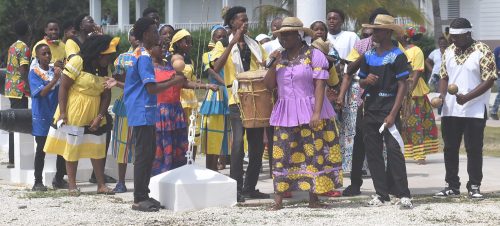
Gulisi Primary School and Ecumenical High student dancers
By William Ysaguirre (Freelance Writer)
BELIZE CITY, Mon. Aug. 4, 2025
Belize celebrated the 191st anniversary of the abolition of slavery in the British Empire with an official ceremony at Government House in Belize City on Emancipation Day, Friday, August 1, which also marked the 187th anniversary of the abolition of the apprenticeship system.
Minister of State, Hon. Dolores Balderamos Garcia deputized for the Prime Minister in receiving the salute and inspecting the Guard of Honor mounted by the Belize National Coast Guard
“If slavery is not wrong, nothing is wrong”, Minister of Foreign Affairs and Culture, Hon. Francis Fonseca quoted U.S. President Abraham Lincoln as saying, in his keynote address. Lincoln wrote those words in response to his critics in Kentucky when the Emancipation Act was proclaimed in the United States.
“Freedom from slavery was not a gift, but was achieved through the resistance, rebellion and resilience of African slaves and their descendants,” Fonseca stated. It was about a people who shook off their mental shackles, as they removed the physical manacles, who refused to be enslaved.
Fonseca noted, “We look to the future with hope and promise. For us in Belize, Emancipation Day is about remembrance, education and cultural pride.”
He went on to say, “We must continue the important work of decolonizing our society, and in particular, our education system. Our schools and communities must learn about African heritage.” He further affirmed that fostering cultural pride and national unity is an ongoing process as we work to dismantle existing systems of oppression. The fight continues against new forms of slavery – human trafficking and the exploitation of migrants who have left their homes in search of a better life.
“Belize stands for peace, justice and the right to self-determination,” Fonseca avowed, as he emphasized that Belize must continue to improve its education system, healthcare and land distribution to build the economy and secure our continued freedom.
History is often distorted by who records the history of events, and Europeans worked hard to erase African identity, noted Rolando Cocom, Director of the Institute of Social and Cultural Research. Which is why during the colonial era prior to 1981, we were not taught in school about uprisings when enslaved Africans rebelled against their colonial oppressors and fought to regain their freedom, their sense of humanity, though there is record of at least four such uprisings in Belize’s history. He who writes the history books gets to shape the narrative to reflect their distorted perspective. The Europeans built their empires by violence, enforced by fear, and they justified it all through supremacist ideological beliefs.
In the European narrative, Africa was the “Dark Continent”, with no civilization, when in fact Africa was the cradle of the entire human race, where man developed his first tools, domesticated animals and food crops, developed language and formed societies. Which is why Africa today shows the greatest genetic diversity than any other “race”, with close to 2,000 indigenous languages spoken in 54 countries. Europe was still living in the “Dark Age”, when the kingdoms of Great Zimbabwe, Ghana and Songhai were already trading, governing and building. In Belize, Mayan civilization also reached its zenith when Europe was in the “Dark Age”. Mayan astrologers studied the stars without the benefit of the optical telescope invented by Galileo, yet their mathematicians created a calendar that is more accurate than the Gregorian calendar we use today.
Cocom also declared that on that Emancipation Day they were celebrating Eboe Town, which was located somewhere in a swampy area that is now between South Street and Berkeley Street, according to the historian Aondofe Iyo, but it is where free Africans made their homes and preserved their African traditions, such as drumming, dancing and masquerades, which worried the colonial officials, who were alarmed by what they did not understand. Eboe Town was destroyed by fire in 1819, but African culture survived in other similar communities in Freetown Sibun, “Malanti” (Gales Point Manatee), Boom, Duck Run and many others across Belize.
Emancipation Day not only recalls this struggle, but ensures that Belizeans are taught African history that has been long buried, to live and celebrate African greatness. Cocom acknowledged the contributions of the UBAD Educational Foundation, the National Kriol Council and the National Garifuna Council in the preservation of this cultural identity.
Ministers Balderamos Garcia and Fonseca honored the freedom of the unshackled, oppressed Africans with a symbolic laying of flowers upon the water. The National Garifuna Council and the Ugundani Garifuna Dance Group performed the “Ibagari” ritual. Guests were also entertained by a dance presentation by students from Stann Creek Ecumenical High School and the Gulisi Community Primary School. Belizean poet Kyraan Gabourel recited his Emancipation Day poem “Uhuru”, a Swahili word for freedom; and Creole elder Kashmir Clare of the National Kriol Council gave a libation. Opposition leader, Hon. Tracy Panton; Belize City Mayor, Bernard Wagner; Taiwanese Ambassador, H.E. Lily Li-Wen Hsu; and other members of the diplomatic corps also attended the ceremony