

By William Ysaguirre
(Freelance Writer)
BELIZE CITY, Thurs. Sept. 25, 2025
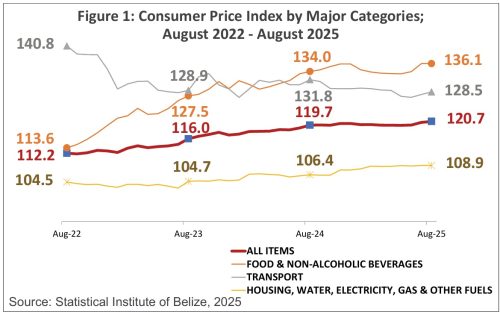
Belize’s inflation rate was 1.3 percent for the first 8 months of 2025, statistician Jaime Crespo of the Statistical Institute of Belize (SIB) reported at the SIB’s quarterly press conference at the Belize Institute of Management in Belize City on Wednesday morning, September 24. The Institute calculates a Consumer Price Index (CPI), based on the average basket of goods and services a household purchases in any given month, which was 120.7 last month—0.8 percent more than the 119.7 CPI reported in August 2024.
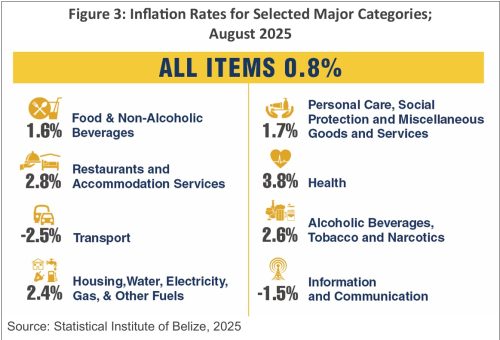
The biggest increase was in the food and non-alcoholic beverages category, in which prices increased by 2.3 percent. The prices of fruit and vegetable juices increased 13.3 percent, bottled water prices went up 8.7 percent, the prices of fruits and nuts shot up by 8 percent, and there was a 7.3 percent hike in soft drink prices. The prices of cereal products went up 2.6 percent, and meat prices increased by 2.0 percent
Housing and utility costs increased by 2.4 percent, as rents went up by 2.3 percent, and the price of cooking gas increased by 8.1 percent; a 100-lb cylinder of butane averaged $128.43 for January to August this year, compared to $119.27/100lb last year.
The price of personal care products went up 3.0 percent overall, with a 5.2 percent increase in the prices of personal hygiene products like deodorants and a 3.2 percent increase in the prices of bathroom hygiene products such as soaps and gels. On the other hand, the prices of house furnishings, shoes and clothing, and alcoholic drinks and tobacco showed only a 0.1 percent increase, while transportation costs fell by 0.2 percent, and communications costs increased by only 0.1 percent.
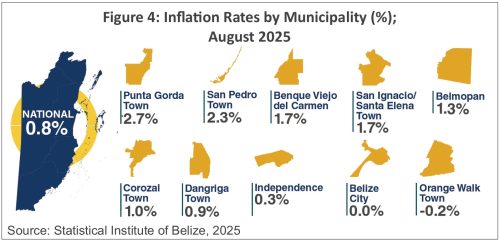
The geographic distribution of the inflation rate showed that San Pedro Town had the highest inflation rate of 3.2 percent. Belmopan was second at 3.1 percent; while Punta Gorda and Corozal reported 2.1 percent inflation. Benque Viejo’s inflation rate was 1.8 percent, San Ignacio’s was 1.4 percent and Dangriga’s was 1.2 percent. In Orange Walk Town, prices went up 0.7 percent, and prices in Belize City increased by 0.6 percent. Only Independence Village showed a 1.1 percent drop in prices.
Belize’s inflation rate compared well with the rest of the region, as Guatemala reported 1.6 percent inflation, while in Nicaragua prices went up 1.8 percent, and in the USA inflation stood at 2.6 percent. Mexico reported 3.9 percent inflation, and prices are up 3.6 percent in the Dominican Republic, 4.1 percent in Jamaica, and 4.5 percent in Honduras. Only Costa Rica, Panama and El Salvador reported lower inflation rates than in Belize.
According to statistician Juan Blanco, the SIB also began a random survey of consumer confidence in the economy last year, calling consumers over 18 years of age who were asked to answer survey questions in a telephone interview. The survey sought to establish their willingness to buy new things: a house, a car, new appliances, and furniture, based on their confidence in the country’s economy. This Consumer Confidence Index (CCI) was 46.8 last month, which was 2.9 percent higher than in July.
For the first 8 months of this year, the CCI was 47.4. The survey also compared the index by district, by age group, by gender, and by ethnicity. Women tend to be more conservative and to have a lower CCI rating compared to men for the same time period. A CCI index over 50 indicates that people have confidence in the economy and are willing to invest, while an index below 50 shows a lack of confidence in the economy. The CCI was 50.5 in January, fell to 49.6 in March, and it had been falling steadily to 45.2 in June, and is now slowly on the rise again.