



Minister of Agriculture – Hon Jose Mai
By William Ysaguirre (Freelance Writer)
BELIZE CITY, Wed. Aug. 13, 2025
Sugarcane farmers in the north of the country must find ways to access funds to buy the fungicides which have proven effective against the Fusarium fungus, or else face the possibility of a steep decline, and perhaps even demise, of the industry.
The Ministry of Agriculture identified the seriousness of the threat when the Fusarium affected 60,000 acres of the cane fields, and caused a 16 percent drop in sugarcane production compared to the last crop and dismal cane quality, which led to a 25 percent shortfall in sugar production.
The Ministry had allocated $500,000 of its annual budget to support small farmers to buy fertilizers, but the fertilizer would have no benefit in fields infected with Fusarium, Minister of Agriculture and Food Security, Hon. Jose Abelardo Mai, explained
“Given the situation with the plants, the physiological effects of the disease on the plants, and guided by technicians, if we were to give out fertilizers, it would be of no use,” Mai lamented. “When the Fusarium disease affects the vascular bundles, which is the ability of the plants to uptake fertilizers or to transport nutrients up and down the plant … so, if we gave them fertilizer, it would be of no use, and would be thrown away because the roots and the plant won’t absorb it,” he further explained.
The farmers have been advised by experts that first they need to control the Fusarium disease, which is destroying the phloem tissue which transports nutrients from the roots up through the cane stalks. Therefore, the first priority is to invest in buying fungicide to kill the Fusarium. Until the cane stalks are healthy and free of Fusarium, any application of fertilizer would be wasted.
The ministry has begun a pilot project of applying the fungicide to 2,500 acres to determine how effective the treatment will be in eradicating the Fusarium. “We hope to finish those treatments by August 22,” Mai said. The 2,500 acres being treated “is a drop in the bucket”, when considering that there are 60,000 acres affected by Fusarium. The farmers have little choice but to invest in the fungicide to kill the disease, or face another poor crop.
But the cost is a limiting factor, when cane farmers compare their cost of production with what they are earning per tonne of cane. “So, if we are at $65-$70 cost of producing one ton of cane, and you are being paid $60, you are negative already,” Mai explained. The farmers had two good years prior to this one, when the prices of the cane they sold to the mill were at a record high of $90.23 per tonne last year. But they did not perceive Fusarium to be such a serious threat, and did not invest a portion of the past two years’ profits to eradicate the fungus, which has had such a devastating impact on this year’s crop, with the dismal sugar yield leading to the low cane price of $65.00 that the farmers are being paid this year.
Mai had announced that the Government of Belize would allocate $2.6 million to fight the Fusarium threat. He spoke when key partners came together to discuss urgent solutions, in a Sugar Cane Brainstorming Session at the Sugar Industry Control Board (SICB) conference room on Monday, June 16.
In addition to $500,000 from its Capital II funds for the pilot project to treat 2,500 acres of sugarcane infected by the fungus, the Agriculture Ministry would access $100,000 from the Inter-American Institute for Cooperation on Agriculture (IICA) for experimental tests with Trichoderma, a native fungus that could help control Fusarium. If Trichoderma proved effective, the University of Belize could mass produce it for farmers at an affordable price.
Another $2 million from the World Bank-funded Climate Resilient Agriculture Project (CRESAP) would strengthen SIRDI’s (Sugar Industry Research and Development Institute) capacity to produce Trichoderma to control the Fusarium. The Ministry would also partner with farmers to introduce new disease-resistant sugarcane varieties.
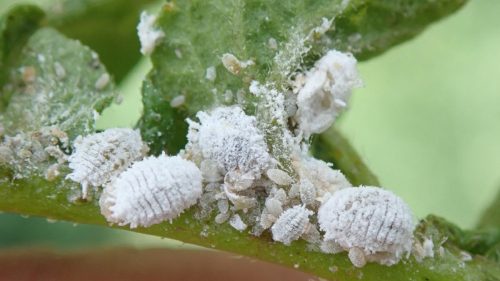
Mealybugs
The Caribbean Community Climate Change Centre (5Cs) would also support the medium-term strategies to manage Fusarium and ensure the long-term sustainability of the sugar industry.
The Fusarium threat is compounded by the attack of mealybugs, which cane farmers have been fighting for a number of years. Farmers have destroyed entire fields to ensure they killed all the mealybugs.
“We have had a history of froghopper; it’s endemic in sugar cane. … About 10 years ago, we started with stem borer, and we have that; and now we have mealybugs,” Mai said. “I saw one field that was infested with mealybug. I took photos of it and sent it to SIRDI; and SIRDI said, ‘Yes, Minister, we are monitoring that field’.”
“They destroyed the field, and it is just one more pest to deal with. It sounds simple, but it is an added cost … at a time when the price of sugar is depressed. So, the farmers are not in the best position at this time, I must say,” Mai noted.