


By Orlando Pulido (Freelance Writer)
SANTA ELENA TOWN, Cayo District, Sun. Oct. 26, 2025
October is Breast Cancer Awareness Month, and as part of its activities in observance of the month, Knitted Knockers, an advocate for breast cancer patients from San Ignacio, sponsored a health talk on breast cancer. The event took place on Saturday, October 25 at the Aguada Restaurant in Santa Elena, where Dr. Veronica Rosado from St. Luke’s Hospital in Belmopan gave a talk on breast cancer.
Dr. Rosado defined breast cancer as a disease in which cells in the breast grow uncontrollably, and noted that it can spread to other parts of the body. Dr. Rosado then told those in attendance, “Lately, with Dr. Ramon Yacab, our oncologist, who is at Karl Heusner, he has been offering chemotherapy; and we also have the Dangriga Cancer Center, which offers chemotherapy.”
However, Belize still lacks radiation therapy, which is very important, especially for breast cancer patients. According to Dr. Rosado, these patients “who have to have money and have to travel abroad, they have to go to Guatemala, to Merida, to Mexico, to El Salvador, to other countries.”
Certain inherited high-penetrance gene mutations greatly increase breast cancer risk, the most dominant being mutations in the genes BRCA1, BRCA2. Dr. Rosado, in reference to the BRCA1 and BRCA2 genes, said, “If you have those genes – you are born with those genes – you will almost for sure have cancer.” The good news is that the BRCA1 gene in Chromosome 17 can now be tested in Belize and sent to Canada for further analysis. The presence of the BRCA1 gene gives a 55% to 65% percent probability of cancer, says Dr. Rosado.
As a result, Dr. Rosado urges women to check their breasts regularly and do manual palpations for early detection of breast cancer.
Dr. Natalia Largaespada Beer is the Technical Advisor for the Maternal and Child Health Unit at the Belize Ministry of Health and Wellness. Dr. Beer agrees that early detection is important.
“We encourage breast self-examination; and at least every month, on a set day, they can just do a palpation of both breasts, look at themselves in the mirror to see that there are no changes in the breast; also, press the nipples so that no type of discharge is occurring; and then we recommend clinical breast exams, which is the examination by a doctor. So, whenever they feel that they have something, they will need to go to a doctor and let him do a clinical breast exam; and then at the regional hospital, we can do the ultrasound for those below 40, so that we can fast-track their access to care and treatment,” she explained.
While early detection is necessary, the statistics are showing that such detection is often not taking place. According to Dr. Rosado, 40% of patients in Belize are getting diagnosed with cancer at stage three. Dr. Beer stated that women are doing biopsies 130 days after symptoms emerge, and accessing treatment 189 days after the onset of those symptoms.
“We need to give this a priority, because the advancement of breast cancer is pretty quick; not like cervical cancer, [where] they have a little bit more chance to access care and treatment; but with breast, I mean, time is very short from symptoms to treatment,” says Dr. Beer.
Dr. Beer further stated, “If you have symptoms before 40 years, we have access to primary health care. It is free; you can go to any clinic by the Government, and a clinical breast exam is free. We also have an ultrasound available at the regional hospital, and that is free. We have radiologists at the regional hospitals, and that is free. So, a lot of opportunities are there. We need to know how our breasts feel and look normally, so that we can identify quickly when there is an abnormality; and as soon as we see something that is not looking normal, find the nearest health facility, raise our concerns so that we can fast-track through the system.”
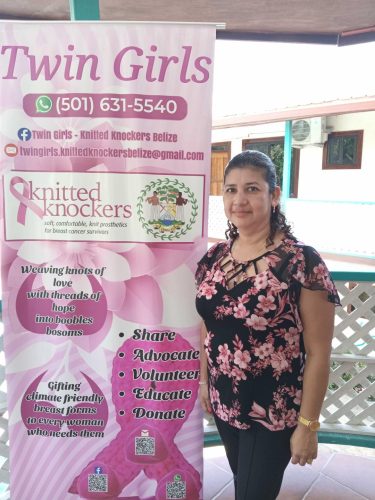
As for Knitted Knockers, their journey began in June 2024, distributing knitted products to breast cancer survivors at St. Luke Hospital, the Karl Heusner Memorial Hospital, Belize Health Care Partners, and the Cancer Society in Orange Walk.
“[These] are comfortable, lightweight, and free of cost,” said Barbara Flowers, administrator of Knitted Knockers, who herself has had to struggle with cancer.
Knitted Knockers meets once a month at the Cayo Welcome Center. They can be contacted at 631-5540.
The toll that a breast cancer diagnosis can take on families is a great one. Iris Belisle from the Aguada Restaurant said that when she found out that her daughter had breast cancer, she was “… in denial … cancer no had to be wahn [sic] death sentence.”
For his part, Thomas Barton encourages husbands to be supportive.
“Men have to be the mechanical provider and give emotional support,” he said.
He continued, “Be ready to help in any way you can. Look them straight in the eye, and don’t flinch.”
A discussion of breast cancer is a relevant one. In 2022, there were an estimated 2.3 million women diagnosed with breast cancer, and 670,000 deaths globally. Breast cancer occurs in every country of the world in women at any age after puberty, but with increasing rates in later life.