


A price hike to further bleed Cubans
By Francisco Acevedo
HAVANA TIMES – Just when we thought things couldn’t get worse, they did. That old saying fits perfectly with what’s happened in recent hours, as Cuba’s Telecommunications Company (ETECSA)—the country’s exclusive telecom provider—has added to the hardships of Cubans by announcing changes to its mobile service rates, plans, and packages, with prices that are simply unaffordable for the majority.
Traditional mobile top-ups in Cuban pesos are now limited to 360 pesos every 30 days, equivalent to just 6 gigabytes (GB) of data.
According to the new pricing, a 15 GB plan costs 11,760 pesos, twice the average national monthly salary. Meanwhile, ETECSA is pushing packages priced in US dollars at $10, $20, and $35—a viable option only for those who receive remittances or have access to foreign currency.
These prices in Cuban pesos for additional data plans closely resemble—or even exceed—the exchange rate for the dollar on the informal market.
The average cost ranges from $2.10 to $2.50 per GB. When compared to Cuban pesos, this implies an exchange rate of around 398 pesos to 1 USD—higher than the lowest exchange rate in recent months, which was 350 pesos per USD. That lower rate was applied to the 15 GB package (11,760 pesos), but for the 3 GB package, the rate is 448 pesos per USD, for example, showing that the rate is not consistent.
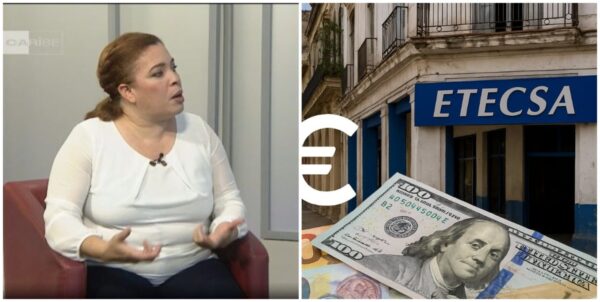
ETECSA’s executive president, Tania Velazquez Rodriguez, tried to defend the controversial price hike during Friday’s Mesa Redonda TV program, blaming the lack of foreign currency and revenues, mainly due to the US embargo (as usual), for the company’s inability to purchase supplies needed to expand or repair services.
In 2022 alone, ETECSA reported a nearly $300 million revenue drop compared to the previous year. That trend has continued, with annual losses in the hundreds of millions. Velazquez acknowledged that the company is facing massive debt.
The disgraced Minister of Economy, Alejandro Gil, had previously blamed part of the problem on the higher informal exchange rate compared to the official one, which made it more profitable for consumers to exchange currency and buy data packages in Cuban pesos. What he didn’t say is that this situation was created by the 2021 Tarea Ordenamiento reforms, a policy he himself implemented.
That’s not even touching on the terrible service: things become a nightmare when there’s no electricity (nearly all day, nearly everywhere), there’s a lack of equipment even for traditional landlines, and the average mobile connection speed is laughable when compared to the rest of the world.
Just like other state-run entities, ETECSA is trying to milk money from outside Cuba, this time from relatives of Cubans on the island, by exploiting the need to stay connected.
But they forget that internet access isn’t just for communication; it’s also for accessing information (including from official government sources), for working remotely, and even for studying—since a significant percentage of school content at all levels is now delivered online.
Public outrage was swift and even figures typically aligned with the regime voiced criticism.
Pedro Jorge Velazquez, a pro-government Cuban journalist known as “El Necio de Cuba,” denounced the move on social media and called on the Communist Party of Cuba and the government to step in and correct ETECSA’s pricing strategy.
“In just a few hours after the announcement, the measure has become extremely UNPOPULAR. I can’t recall another decision that’s caused such instant and widespread dissatisfaction—even among those most loyal to the Cuban government and the socialist process. Analyze the impact and listen to the citizens speaking out. If the measure goes against the interests and needs of the people, it goes against the Revolution,” said El Necio.
Seriously? You think the Communist Party is unaware of what ETECSA is doing, as if the company operates independently? Keep pulling that chain. His statement sounds more like a plea to his bosses to “make the company come to its senses.” Once again, he lives up to his nickname.
Meanwhile, Francisco Rodriguez Cruz, vice president of the Cuban Journalists’ Union (UPEC), criticized the public outcry—focusing instead on those who can afford hotels and expensive cigars, who will continue to do so thanks to relatives abroad. He justified the price hike without acknowledging the millions of Cubans who receive no remittances at all.
I wonder what Francisco will do when his son fails a test because he couldn’t access his teachers’ online study materials—the same Francisco who has previously asked his friends in exile to send him mobile top-ups.
Cuban musician Giraldo Piloto denounced the move on Facebook, calling it a “shame” and highlighting how the change directly affects families, education, and access to uncensored internet.
“Young people will never forgive this!” said the director of the group Klimax, who recently emigrated to the United States in search of a better life.
Cuban singer La Diosa, now living in the US, recalled her past criticism of ETECSA, when she made strong accusations against the company, alleging they were stealing her money.
Six faculties within the pro-government University Student Federation (FEU) openly rejected the new rates, arguing that they limit the right to information and education. They stated that the measures harm academic development and called for an urgent review that considers the real financial situation of students.
Tania Velazquez met on Saturday with FEU leaders to offer alternative solutions like free access to certain websites and other “nonsense” that solves nothing. She promised to review the extra data rates—but we all know how those promises end.
This is just one more step toward the dollarization of basic services on the island. Can you imagine if the Electric Company now announced that Cuban households can use a limited amount of kilowatts and would have to pay in dollars for anything beyond that?
In the end, the Ministry of Energy and Mines faces the same difficulties as ETECSA in sustaining and developing its infrastructure.