


Exxon’s upstream strategy relies on Guyana’s cheap, high-quality oil returns
Dec 12, 2024
Kaieteur News- Guyana’s Stabroek Block is one “advantaged asset” in ExxonMobil’s upstream portfolio that offers the American oil giant, lower cost of supply and higher returns.
On Wednesday, Exxon unveiled its Corporate Plan to 2030, emphasizing strategic investments in key regions, including Guyana, to bolster shareholder value and strengthen its upstream portfolio. The company aims to deliver an additional US$20 billion in earnings and US$30 billion in cash flow by leveraging competitively advantaged opportunities and disciplined cost management.

CEO of ExxonMobil, Darren Woods
The plan underscores ExxonMobil’s focus on upstream production growth from advantaged assets like Guyana, the Permian Basin and liquefied natural gas (LNG) projects. “By 2030, more than 60% of the company’s production is expected to come from these advantaged assets, which are expected to grow by an additional 1.2 million oil-equivalent barrels per day (Moebd) during that period. Total Upstream production is expected to reach 5.4 Moebd by 2030, even as the company plans to lower its operated upstream emissions intensity 40-50% versus 2016,” Exxon said.
In Guyana, ExxonMobil plans to add two more oil developments in the Stabroek Block, Hammerhead and Longtail, bringing the total number of sanctioned projects in the country to eight by 2030.
Exxon is the operator of the Stabroek Block which covers an area of 6.6 million acres is estimated to hold 11.6 billion barrels of oil. To date, Exxon has obtained approval from the Government of Guyana for six development projects in the Stabroek Block – Liza Phase One, Liza Phase Two, Payara, Yellowtail, Uaru and Whiptail. The first three projects are already producing oil at a daily estimated rate of 640,000 barrels per day (bpd). With the addition of Hammerhead and Longtail, Exxon said this will expand gross production in Guyana to approximately 1.3 million barrels per day, with total production capacity expected to reach 1.7 million barrels per day on an investment basis.
“ExxonMobil continues to strengthen its upstream portfolio of advantaged assets that offer lower cost of supply and higher returns. By 2030, at a 2024 dollar real Brent price of US$65 per barrel, a real Henry Hub price of US$3 per mmbtu, and a real TTF price of US$6.50 per mmbtu, the company plans to deliver an additional US$9 billion in Upstream annual earnings potential – more than 50% higher than in 2024,” it was stated. This publication recently reported that Vice President Bharrat Jagdeo has argued that Guyana’s low-cost production and quality crude position the country advantageously, allowing it to derive long-term benefits from its oil reserves. Jagdeo was at the time responding to questions in relation to a potential oil glut causing a decline in oil prices – thereby affecting Guyana.
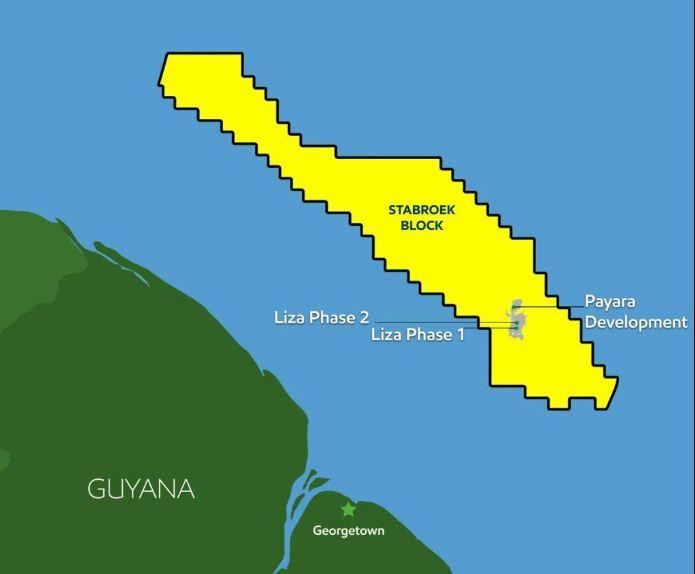
The Stabroek Block. (Exxon’s upstream strategy)
Reflecting on Guyana’s strategic advantage, Jagdeo emphasized that the country’s light, sweet crude oil—widely regarded for its quality—combined with low production costs of about US$40 per barrel, puts it in a stronger position than many other oil-producing nations. “The good thing is that our crude is light, sweet crude. It’s a good quality crude, and also our breakeven cost is below many countries in the world. So if you had to fall off the production chart on the basis of quality of crude and breakeven cost, many other countries will fall off before we fall off the chart,” he asserted. He underscored that Guyana’s production is low-cost compared to other countries, making it less vulnerable in scenarios where only the most economical producers survive a downturn. Jagdeo said, “So before those prices fall below a point where we can’t produce oil anymore, lots of other countries, should there be a reduction in global demand, would fall off the production chart ahead of us.”
(Exxon’s upstream strategy relies on Guyana’s cheap, high-quality oil returns)
Related
Similar Articles