


Ofsted has unveiled its plans for “fairer” school report cards with a five-point grading system across up to 11 areas, the end of ungraded inspections and increased monitoring of under-performing schools.
But unions have warned the new model is “worse than single-word judgments”, which were scrapped last year, and will cause “yet more misery”.
The changes, announced in a consultation launched today, were prompted by a coroner’s ruling in 2023 that an inspection of Caversham Primary School in Reading “contributed” to the suicide of its headteacher, Ruth Perry.
Ofsted chief inspector Sir Martyn Oliver said he believed the system will offer a “more balanced, fairer approach”, with more room for “nuance” than the “binary” one-word judgements.
“This process will give fairer, more rounded, better information, both to the school and to parents, as well as taking into [account] the context of a school and the individual strengths and areas of improvement.”
You can read a full explainer on the changes here, and a Q&A with Oliver here.
Ratings: from ‘causing concern’ to ‘exemplary’
Under the proposals, new “report cards” will be used to assess schools and convey their performance to parents.
Instead of single-word judgments, Ofsted is proposing to now rate schools across up to 11 different areas.
Every school would be judged on leadership and governance, curriculum, developing teaching, achievement, behaviour and attitudes, attendance, personal development and well-being, inclusion and safeguarding.
Those with early years provision or sixth forms would receive an additional grade for each area.
Across all areas but safeguarding, schools will be given one of five colour-coded judgments: exemplary (in dark green), strong, secure, attention needed, or causing concern (in red).
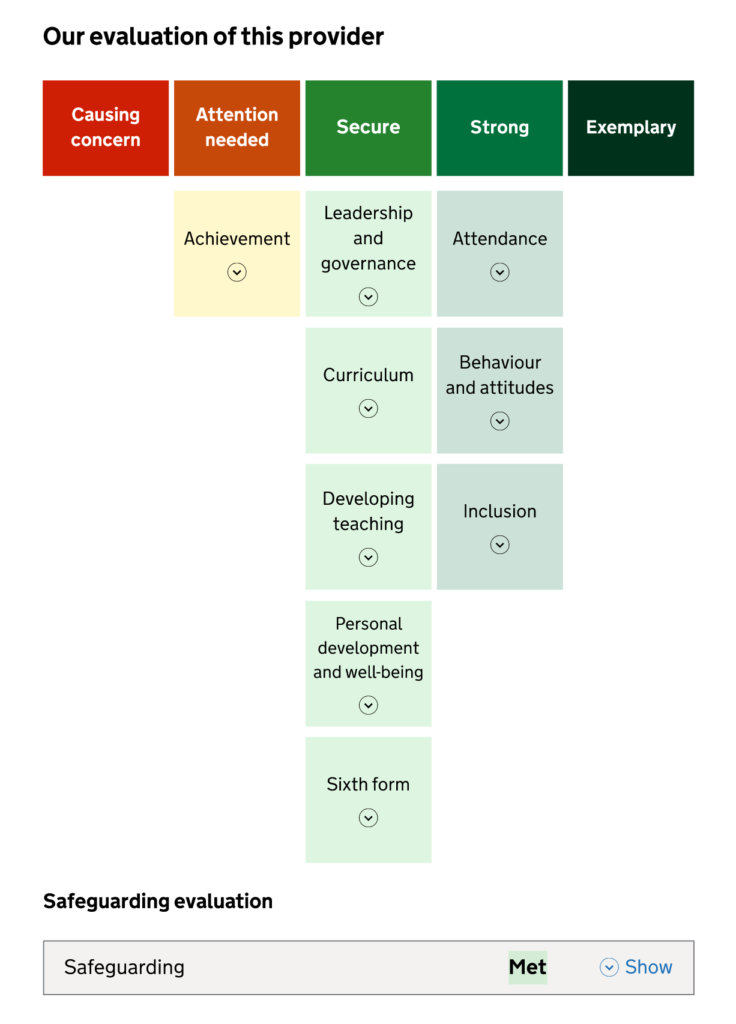
In safeguarding, schools will be deemed to have either “met” or “not met” their requirements.
As well as these headline grades for each area, Ofsted will publish short descriptions summarising their findings.
Monitoring inspections for ‘attention needed’ schools
Ofsted also wants to more frequently monitor schools that are under-performing.
Schools with at least one ‘attention’ needed rating will get monitoring inspections, but they will focus only on those areas.
Oliver said this would “check that timely action is being taken to raise standards”. If schools have improved, they won’t have to “go through the rigmarole” of a full inspection and the rating will be upgraded.
“But if they don’t improve and they haven’t made an acceptable standard of education, we will clearly and unapologetically call it out as we are going to raise standards for this new way of working,” Oliver added.
Schools falling into a “category of concern” will still be identified, and eligible for government intervention. The Department for Education is expected to publish details of its intervention plans today.
Schools will be placed in ‘special measures’ if any area (except leadership) or safeguarding is a concern, *and* leadership is also a concern. Those schools will get six monitoring inspections over 24 months.
A school will ‘require significant improvement’ if any area (except leadership) or safeguarding is a concern, but leadership is not. These schools will get five over 18 months.
The inspectorate will free up resources for more frequent monitoring inspections by scrapping ungraded inspections.
Oliver said he was “confident that we can deliver our plans”. He also hopes to announce more “exciting things to improve our inspection model going forward” after the government spending review.
More information on schools’ demographic
Inspections and report cards will also give more context on a school’s setting.
They will include data on elements such as children from disadvantaged backgrounds, those with SEND, pupil outcomes, absence and attendance, and information about the local demographic.
Oliver said he wanted providers “to take the most difficult, the most disadvantaged, the most vulnerable children, and say that they know that Ofsted will have their back if they do that difficult work.
“It’s clearly nonsense if the inspectorate and regulator is at any point an excuse for people to avoid our most vulnerable children, and that’s something I’m very clear about,” he added.
Curriculum deep dives will also be scrapped and new toolkits to help schools understand what inspectors look for in each area will be published.
Every school will also be asked to nominate a senior staff member to work closely with the inspection team, a model employed in further education inspections.
‘Worse than single-word judgments’
But unions have been heavily critical.
Pepe Di’Iasio, general secretary of the ASCL leaders’ union, said the proposed report cards were “worse than single-word judgements”.
Ofsted and the government “appear to have learned nothing from the death of headteacher Ruth Perry”, he added, and said the new system will lead to “yet more misery” for the profession.
The new system would be “bewildering” for teacher, leaders, and parents and that teachers “will vote with their feet by leaving”.
Paul Whiteman, general secretary of school leaders’ union NAHT, said retaining sub-judgments “risks replicating the worst aspects of the current system and will do little to reduce the enormous pressure school leaders are under”.
Daniele Kebede, general secretary of the National Education Union, said the proposals “will make matters worse, not better”. He said Oliver “has failed to deliver” the changes needed, and “has ignored the voice of the profession”.
“He has set a course for Ofsted to remain just as out of touch as before, just as crude in its assessments,” he said, saying the proposed grading scale “maintains the current blunt, reductive approach that cannot capture the complexity of school life nor provide more meaningful information to parents”.
It comes after Schools Week reported the concerns of whistleblowers from inside Ofsted, who warned report cards had been “cobbled together at ridiculous speed” and that leaders had ignored concerns from experienced staff.
Positive response from pilots, says Ofsted
However, Lee Owston, Ofsted’s national director for education, claimed on Friday that across six trials conducted at schools so far, the “overwhelming” response to the proposal has been “very, very positive”.
“The purpose of those trials was to get reaction in terms of what it is that we’ve written what it is that we’re proposing, and of course, we have made adjustments and tweaks.”
Oliver added that following the trials he believes the proposal “will be met from parents and providers with a great deal of interest”.
“And there’ll be some concern, but also a tremendous amount of excitement, especially in the methodology of all of the things we’re going to propose,” he said.
The consultation will run for 12 weeks until April 28, with more pilot inspections due to be carried out in coming months, before a report and more trialling in the summer.
A new inspection framework will then be introduced in September, with the return of inspections after the summer break delayed until November to allow for trialling of the new model and inspector training.