


Guyana slams China’s silence on Venezuela’s provocations
Apr 18, 2025
…rejects suggestion for “friendly negotiations” to resolve border controversy
Kaieteur News- The Government of Guyana has called out the People’s Republic of China for its continued silence on Venezuela’s provocative actions amid the ongoing border controversy and Caracas’ intention to conduct elections in Essequibo.
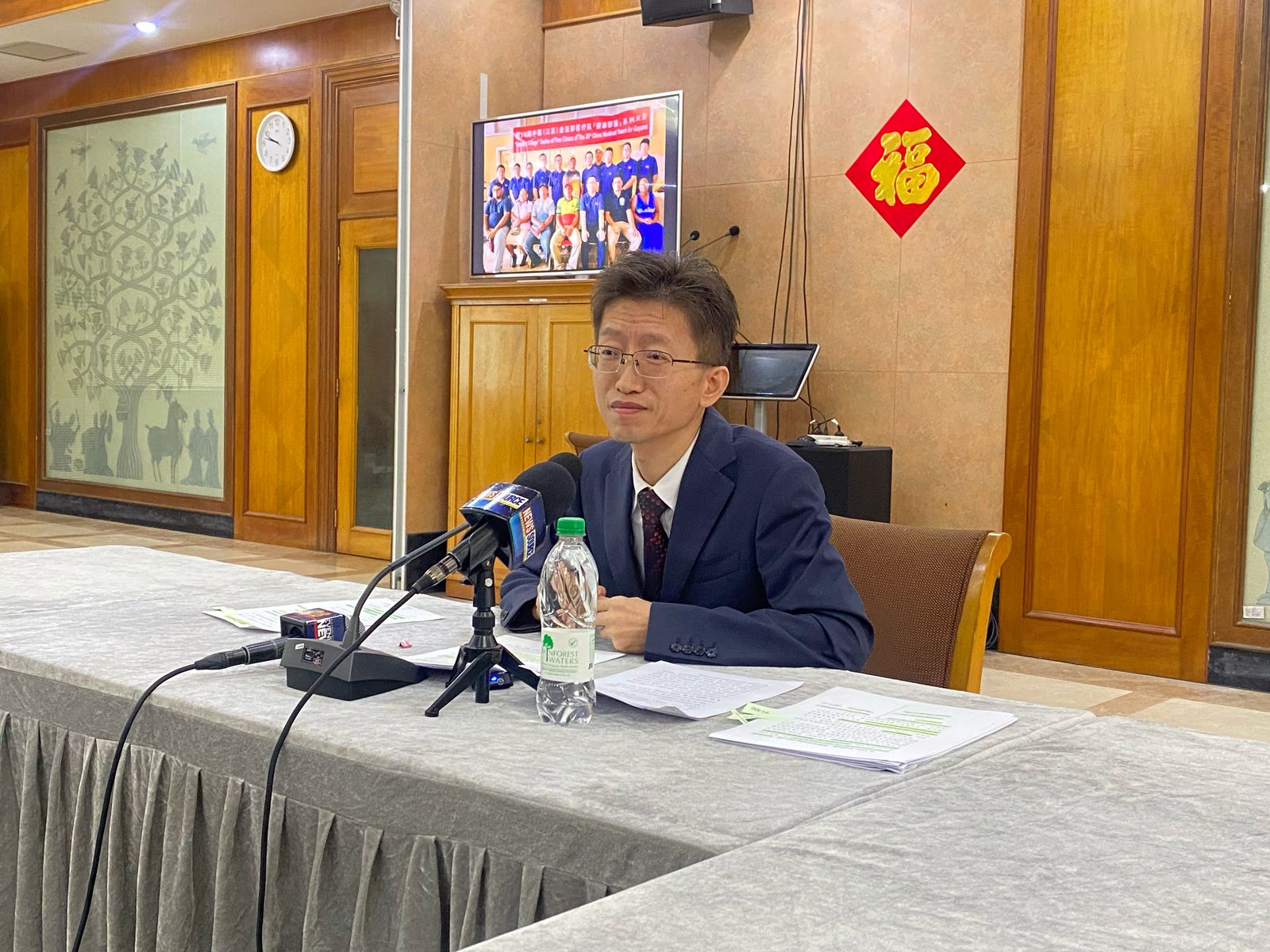
China’s Deputy Chief of Mission to Guyana, Huang Rui
In a statement issued on Thursday, Guyana’s Ministry of Foreign Affairs and International Cooperation said it has “taken note that there has been no comment from the Government of the People’s Republic of China on Venezuela’s plan to hold elections on May 25, 2025, in what it has declared the “Guayana Esequiba State” which is the name Venezuela has given to Guyana’s Essequibo region.” The ministry noted that this move by Venezuela is a clear violation of Guyana’s sovereignty and territorial integrity.
This sharp rebuke follows remarks made by China’s Deputy Chief of Mission to Guyana, Huang Rui, during an embassy press conference on Wednesday in Georgetown where he initially suggested the long-standing border controversy between Guyana and Venezuela could be resolved through “friendly consultations and negotiations.” Although Rui later retracted the comment, Guyana made it clear that such suggestions are unacceptable, as the matter is already before the International Court of Justice (ICJ).
“The Ministry of Foreign Affairs and International Cooperation rejects the statement made on April 16, 2025 by the Charge d’Affaires of the Embassy of the People’s Republic of China that Guyana and Venezuela can solve the border issue through friendly consultations and negotiations,” the statement said.
Reiterating Guyana’s longstanding position, the ministry noted that the issue is being adjudicated by the ICJ in accordance with the 1966 Geneva Agreement. “Guyana will not engage in discussion of any matter that has been brought before the Court. To do so would be to undermine the jurisdiction and authority of the International Court of Justice,” it was stated.

Vice President, Bharrat Jagdeo
Notably, China’s Deputy Chief of Mission to Guyana Rui, has stated that China will not interfere in the Guyana and Venezuela border controversy. He said China maintains a strict policy of non-interference in other countries’ internal affairs. “If you actually follow the Chinese foreign policies, all those policies, as long as possible, you will see, first of all, we never intervene in internal affairs of any nation. The second principle is we always respect [other countries] sovereignty and territorial, that’s all,” Rui added.
For his part, Vice President Bharrat Jagdeo said at his press conference said that given that Guyana’s national position has always been that the matter will be resolved by the ICJ, for China’s Deputy Chief of Mission to suggest going back to bilateral talks “is improper now to place, and that is what this statement mentioned, because it’s not respectful of our national position.”
Rui’s remarks about friendly negotiations came amid heightened tensions between Guyana and Venezuela over the long-standing border controversy regarding the resource-rich Essequibo region, which spans over two-thirds of Guyana’s landmass.
The Guyana-Venezuela border controversy is currently before the International Court of Justice. Despite a December 2023 agreement between President Ali and Venezuelan President Maduro committing to regional peace, on March 1, 2025, a Venezuelan naval vessel entered Guyana’s waters and approached Exxon’s Prosperity Floating Production Storage and Offloading (FPSO) vessel operating in the oil-rich Stabroek Block and radioed that the FPSO was operating in disputed territory.
The Stabroek Block is operated by American oil major ExxonMobil, which holds a 45 per cent interest, Hess with 30 per cent, and China National Offshore Oil Corporation (CNOOC), a Chinese state-owned entity, with a 25 per cent stake. Rui’s remarks were in response to questions about whether CNOOC’s offshore presence signalled broader Chinese involvement, particularly in the face of Venezuela’s aggression.
The Government of Guyana has insisted on the ICJ’s role in providing a conclusive judgment on the matter, noting that it has no intention of having direct dialogue with the Nicolas Maduro regime regarding the border controversy.
Related
Similar Articles