


By William Ysaguirre (Freelance Writer)
BELIZE CITY, Thurs. Oct. 30, 2025
All 75 Belizean students who could not evacuate from Jamaica have been accounted for and found safe after the strongest storm in history, the Category 5 Hurricane Melissa flattened the western half of Jamaica on Tuesday, and wreaked havoc with widespread flooding as it crossed over Santiago de Cuba on the eastern part of that island as a Category 4 hurricane on Wednesday, October 29.
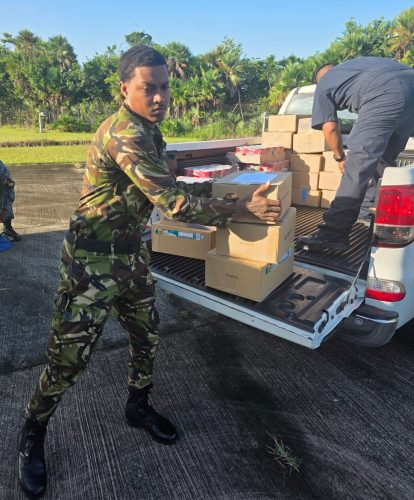
Belize’s Honorary Consul Ms. Elecif Arthurs opened her home in Kingston to give shelter to many students who lived off campus, and she is now preparing to distribute the relief supplies which Ministry of Foreign Affairs, Foreign Trade, Culture and Immigration has dispatched to the affected students on Thursday, October 30.
A Jamaica Defence Force aircraft transported the first relief consignment of supplies, which included canned food and essential personal hygiene items and supplies. The aircraft had been flown to Belize to shelter it from the storm.
The Belize Embassy in Havana, Cuba, will coordinate the distribution of relief supplies which the Government of Belize has provided for the Belizean students in Santiago de Cuba.
Minister of Foreign Affairs Hon. Francis Fonseca thanked the Jamaican authorities, saying, “We are deeply grateful to the Government of Jamaica for their care and support to our students during Hurricane Melissa. Belize remains committed to ensuring their well-being and stands in solidarity with Jamaica during its recovery.”
Jamaica’s Prime Minister, Andrew Holness has declared the entire island a disaster area, and seven deaths have been confirmed so far, in Melisssa’s wake. The Category 5 hurricane tore off roofs of most of the buildings, including the hospital in the town of Black River where it came ashore with 185-mile-per-hour winds, with gusts of over 200 mph. The lowest air pressure recorded of 893 millibars in the eye, made Melissa the strongest storm on record to hit the Caribbean region, and the partial vacuum in the eye produced a 13-foot tidal surge that caused widespread flooding, along with the 30 inches of torrential rains that preceded the storm’s landfall. The wind tore all the leaves from the trees, as it uprooted trees, blocked roads, and blew down electricity poles, leaving 70 percent of the country without power.
Holness flew over the entire island by helicopter to reach areas where roads were impassable, as he walked through the damaged areas and spoke to his people in his nationwide assessment tour. Emergency workers have begun to clean-up the layer of mud left behind by the flood, as the survivors struggle to salvage what personal belongings they can find from homes reduced to matchwood and rubble by the storm. Most of the windows have been broken on the cars and vehicles that were not swept away by the flood, as the 200 mph winds turned debris into flying projectiles that shattered even the hospital windows, where the nurses on duty persevered in giving care to their patients by flashlight after the power went out.
The cleanup effort’s first priority for mud and silt removal was the Norman Manley airport, which is located on a peninsula across the harbor for Kingston, so that emergency flights could begin to bring in relief supplies. The hurricane destroyed the crops in the western part of the island, which is also the country’s food basket, so the Jamaican people will be needing food supplies for months to come as they struggle to rebuild, as Holness pledged they will recover and rebuild.
Haiti and the Dominican Republic were spared the worst of the storm’s winds, but 20 people died in Haiti in the mudslides produced by the flooding from the heavy rains. Thousands more were left homeless in the Dominican Republic, taking refuge in shelters as the floods inundated their homes and crops.
Melissa was still a Category 3 storm with winds over 115 mph as it departed Cuba for the Bahamas, where most of the inhabitants had been airlifted to safety from the island of Inagua, which was directly in the path of the storm.
Melissa left the Bahamas as a Category 2 hurricane with 105 mph winds, as it proceeded northeast at 31 mph heading for the island of Bermuda, where it will pass near late Thursday night. The storm is not expected to make landfall on the American mainland, as it passes close to Nova Scotia, headed for Greenland.