


THE HAGUE, Wed. Nov. 26, 2025
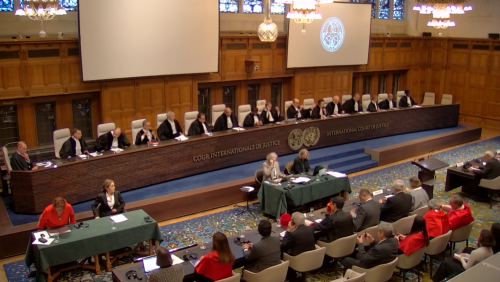
The International Court of Justice (ICJ) has reserved judgment on Guatemala’s application to intervene in Belize’s November 16, 2022 case against Honduras regarding sovereignty of the Sapodilla Cayes – a cluster of islands at the southern tip of Belize’s Barrier Reef in the Gulf of Honduras. The ICJ’s 15-judge panel, led by President Yuji Iwasawa, today concluded three days of public hearings at the Peace Palace in The Hague, Netherlands. The Court will now deliberate and announce its decision at a later date.
Guatemala argued that its longstanding claim to the Sapodillas, which it calls Cayos Sapotillos, could be prejudiced if the Belize v. Honduras case proceeds without its participation. Belize raised no objection to Guatemala’s request, while Honduras urged the Court to dismiss it outright.
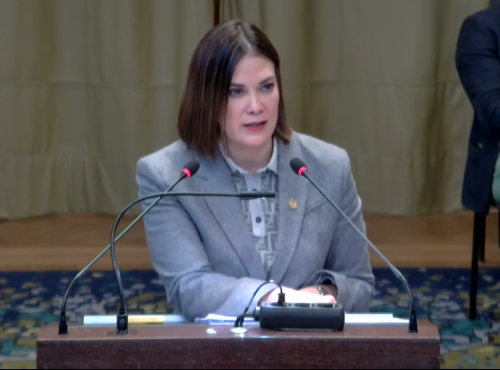
Guatemala’s Agent, Ambassador Ana Cristina Rodríguez Pineda, opened the first round of arguments on Monday by stressing that Guatemala’s participation is essential if the Court is to “give a fully informed decision in the present case.” She emphasized that Guatemala’s application was not intended to introduce new sovereignty claims against Honduras, but rather to safeguard its legal interests in a dispute that overlaps with the pending Guatemala v. Belize case filed on June 12, 2019. In its 7-page written application dated December 1, 2023, Guatemala clearly outlined its objectives: “To protect the rights and interests of Guatemala over the Sapodilla Cayes by all the legal means available” and, “To inform the Court of the nature and extent of Guatemala’s rights, which may be affected by the Court’s decision on the issue of sovereignty over the Sapodillas.”
In its oral pleadings, Guatemala stressed that Belize’s decision to file a separate case against Honduras, unilaterally and without prior notification to Guatemala, created a “procedural conundrum” for the Court by generating overlapping proceedings. Rodríguez Pineda argued that Belize’s move risked prejudging Guatemala’s insular [islands] claim by introducing new arguments and evidence “through the back door of another case involving a third State.” According to Rodríguez Pineda, Belize is seeking to have the Court dispose of an important aspect of Guatemala’s claim without Guatemala’s involvement.
Sir Michael Wood, senior counsel for Guatemala from the Bar of England and Wales, told the judges during the second round of oral hearings today: “Guatemala also claims sovereignty over those cayes. In such circumstances, it is only right for Guatemala to be permitted to intervene to inform the Court of its interests of a legal nature that may be affected by the Court’s decision, and to protect those interests.”
Guatemala underscored that for 160 years, only Guatemala and the United Kingdom claimed sovereignty over the islands, and it was not until January 20, 1982 that Honduras incorporated the claim into its constitution. Prior to that, Guatemala noted, Honduras had partly similar views on the legal title to the islands: that Spain held sovereignty until independence in 1821; that Britain repeatedly recognized Spanish title; that the activity of British settlers did not displace Spanish sovereignty; and that the 1859 Boundary Convention did not extend to the islands.
Guatemala accuses Honduras of opportunism in its claim, noting that Honduras often expressed public support for Guatemala’s position on the cayes, including in statements at the United Nations General Assembly. Once Honduras asserted its claim, however, Guatemala says Honduras’ focus shifted primarily to securing fishing rights at the Sapodillas. Guatemala cited a Belizean Note of Conference dated October 17, 2001, drafted by Ambassador Moises Cal, in which then Ambassador Assad Shoman is quoted as saying, “Belizeans would never consider Guatemala’s involvement in a joint administration of an ecological park over the Sapodillas. Therefore, it is up to Belize and Honduras to come up with a bilateral approach. Belize could reach an amicable agreement with Honduras over fishing rights, since this seems to be one of Honduras’ major concerns.”
The note also recorded remarks by Honduras’ representative, Ambassador Carlos López, who stated, “The Sapodillas must be looked at from a tripartite position. However, it [is] not Honduras’ intention to affect the ‘status quo’, nor sovereignty. Perhaps the Sapodillas could be declared an Ecological Park managed and conserved by three countries. Leave the sovereignty affair out of this . . . keep it frozen. With time Belize will forever end up with the cayes. This approach can save face for both Honduras and Guatemala.” In this week’s proceedings, Belize agreed with Guatemala’s observation that “having made a claim in 1981, Honduras then left it dormant.” Likewise, both states noted that Honduras could have applied to intervene in the Guatemala v. Belize case but chose not to do so.
While Belize does not object to Guatemala’s intervention, Belize’s Agent to the ICJ, Assad Shoman, told the court that permission should only be granted if the Court is of the view that it would assist its deliberations.
Shoman underscored Belize’s interest in ensuring the full resolution of all territorial claims against it. He suggested that the Court coordinate the two overlapping cases in such a way as to minimize duplication: “It would be logical for the Court to hear Guatemala v. Belize first and then, immediately or very shortly thereafter, to hear the more confined case of Belize v. Honduras,” he said. Shoman noted that Belize has been ready for the hearing of the Guatemala v. Belize case for more than two years, with its Rejoinder having been filed in June 2023.
Belize’s counsel, Ben Juratowitch KC, addressed Honduras’ claim of traditional fishing rights and informed that Belize would object to the Court’s jurisdiction on that matter.
Juratowitch was keen to correct Guatemala’s characterization of Belize’s claims in the two cases. In the Honduras case, he affirmed: “Belize claims sovereignty not only on the basis that the United Kingdom became sovereign before 1821, but much more importantly, because of the bilateral course of conduct since Honduras’ independence. For more than a century and a half, the United Kingdom exercised sovereign authority over the Sapodilla Cayes openly, continuously and peacefully, and Honduras not only acquiesced in the assertions of sovereignty constituted by that conduct but positively recognized British sovereignty. The result was that the settled position between Honduras and the United Kingdom in respect of the Sapodilla Cayes was that the United Kingdom was sovereign and Honduras was not.”
Turning to the Guatemala case, Juratowitch explained that it centers on the interpretation of the 1859 Boundary Convention and subsequent treaties: “The key subject of debate is the terms and effect of the 1859 Convention between Guatemala and the United Kingdom relative to the Boundary of British Honduras, and of the 1931 Exchange of Notes that followed it. That is a debate about treaties and, again, does not depend on the position before 1821,” he said.
Juratowitch did urge the Court that if it decides to grant Guatemala’s intervention, it should ensure the measure does not become merely an opportunity for Guatemala to advance submissions principally relevant to the Guatemala v. Belize case.
Led by its Agent, Patricia Licona Cubero, who delivered her intervention in French, Honduras took a firm stance against Guatemala’s application. Professor Alejandro del Valle Gálvez argued that Guatemala’s application is redundant because its interests are already safeguarded in its separate case against Belize. He further argued that the application was procedurally defective, and that it introduced a new dispute and amounted to an abuse of process. Accordingly, he urged the Court to dismiss it. Honduras also maintained that Guatemala’s intervention would only delay proceedings and create confusion between the two cases. Del Valle Gálvez also expressed concern that both Belize and Guatemala had strayed into substantive arguments that were irrelevant to the incidental intervention proceedings. He said Guatemala had “mainly used these hearings to discuss questions of substance relating to the Guatemala/Belize case, which are foreign to the Zapotillos case” and that they would not discuss issues regarding the merits of the Zapotillos case. He stated, “Counsel for Belize have already indulged themselves enough on these topics.”
The Sapodilla Cayes include Northeast Sapodilla Caye, Nicholas Caye, Hunting Caye, Lime Caye, Ragged Caye, and Seal Caye, among others. The cluster of islands is located an estimated 75 kilometers east of Punta Gorda Town. Belize asserts more than 200 years of uninterrupted possession of the islands, first under British colonial administration and later as part of independent Belize. It points to acts of sovereignty such as the construction of lighthouses, regulation of fishing, and the conduct of military patrols. According to Belize’s application, Honduras had previously acknowledged British sovereignty, including in a 1913 letter from the Honduran Foreign Minister thanking Britain for deploying a warship to prevent revolutionary activity on the islands, which he described as “islands belonging to the Colony.”