


CCJ ends decades-long monitoring in Maya Land Rights case
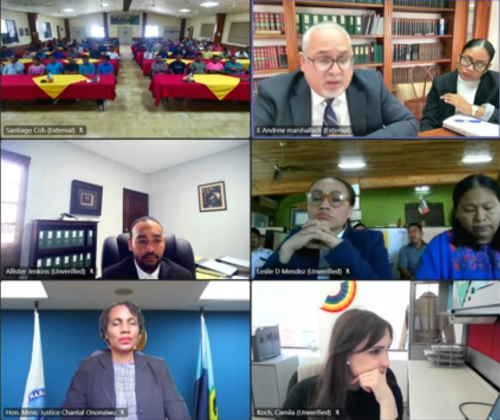
BELIZE CITY, Thurs. Oct. 30, 2025
The Caribbean Court of Justice (CCJ) today brought to a close its monitoring of the implementation of the April 22, 2015 judgment and Consent Order in the Maya Land Rights case that affirmed that Maya customary land tenure in Southern Belize is a constitutionally protected right. The process was always meant to culminate in legislation being enacted to give effect to the Consent Order. While that is still outstanding, after 10 years of monitoring hearings, CCJ President, Hon. Justice Winston Anderson stated today that the Court’s monitoring function has “ran its course.” The first monitoring hearing was held in October 2015.
The parties delivered a final update to the Court on progress made since the last monitoring hearing in September. These effectively served as closing arguments in the matter.
The Government has drafted a bill that has been circulated to the Appellants and is now to be reviewed by a four-member panel comprising two representatives from each side. Minister Dr. Louis Zabaneh and Minister of State, Dr. Osmond Martinez will represent the Government. Stephen Anaya and Moira Gracey will represent the Appellants. According to lead attorney for the Government, Andrew Marshalleck, SC, the review panel can make recommendations for changes to the Maya Customary Land Tenure Policy. The panel will present a report with recommendations, after which the bill will be reconsidered and eventually circulated to the public for wider consultation.
In a prepared statement read by Marshalleck on behalf of the Attorney General and the Government of Belize, it was affirmed that, for the first time, there is draft legislation that “sets out a scheme for recognizing and protecting Maya customary land tenure in Southern Belize.” While the Government recognizes that the draft is not perfect, it described it as “a good faith effort to make land available to the Maya of Southern Belize to preserve their way of life, while at the same time respecting the rights of Belizeans of other ethnicities to some space within the Toledo District for the benefit of their own communities.” The Government characterized the issue as a “land dispute between brothers and sisters” – an affirmation that the Appellants reject. Nonetheless, the Government maintains that it also has a duty to people of other ethnicities and remarked, “There is only one Toledo District.”
The draft legislation automatically recognizes core spaces for the 41 Maya villages in Southern Belize, and reserves those spaces for the Maya into perpetuity. The Government stated that once this land is recognized, it “can never again be bought or sold.” Maya villages can then apply for recognition of additional land once they can demonstrate 30 years of continuous use and possession. The Government explained that “30 years continuous possession is, in any event, enough to defeat a simple title given under the existing land title system.” While the finer details remain to be worked out, the Government refers to the draft legislation as a starting point for meaningful discussion and analysis.
Attorney Leslie Mendez, one of the counsels for the Appellants, underscored the deep divide between the two parties’ positions. She affirmed that their fundamental objections to the Maya Customary Land Tenure Policy remain unchanged, and that the draft bill “has hardened those objections.” She described these as “not minor or incidental to their rights, but they go to the core of Indigenous rights.” Referencing the review panel, she informed that the Maya people “would not be in a position to expend invaluable and scarce resources in a process geared towards principally ensuring compliance with the Policy.” According to Mendez, based on the terms of reference of the review panel, the representatives from both parties would be engaging in a process “where there was a very different view of the nature and purpose of that review panel.” Mendez noted that the Appellants understood the purpose of the review panel to be an audit of the legislation’s compliance with the rights of the Appellants, the Consent Order and the Constitution – “not with the Policy, not with the instruction of Cabinet.” Mendez was emphatic that the rights of the Maya people which must be protected and attract legal obligations “do not arise from Cabinet’s benevolence or its opinion.” She reiterated that the policy fundamentally reflects Cabinet instruction, which the Appellants do not support. Mendez instead called for the parties to revisit the roadmap and for there to be public consultations and concluded, “we will be looking at all other options.”
Cristina Coc, Spokesperson for the Toledo Alcaldes Association, addressed the Court with a pointed statement reflecting the frustrations of the Maya communities. Ten years after the landmark ruling, Coc said the Maya people “continue to be met with a recalcitrant government who dragged us through this long process, consistently acting in bad faith…” She asserted that the Government listened to their input only because of the Court’s insistence, but in the end, rejected all their views and contributions. Coc argued that this behaviour reveals “that this Government does not care about Belize’s Indigenous peoples, and is hell bent on continuing to deny us our rights and to limit our lands, even in the face of legal judgments that affirm these very rights.”
Coc concluded her remarks with a firm affirmation of Maya resilience, and stated that, like their ancestors who did not surrender, “neither shall we.” She expressed heartfelt gratitude to the Court and to every judge who participated in the process. To the Government she said, “I give you highest assurances that my people remain resolute in our defense for our rights to all our ancestral lands, and we continue to hope for a just resolution, because without hope, there is no resistance to injustice and oppressive systems.”
On a more positive note, Mendez acknowledged that the dispute resolution framework has proven useful in addressing, in the interim, some of the encroachments in the Maya communities. She also expressed hope that the Free, Prior and Informed Consent (FPIC) protocol can be strengthened in the legislation, drawing on lessons learned from the application of the current working document.
Court-appointed expert praises CCJ’s oversight
For an estimated six of the ten years that the CCJ provided oversight in the process, Professor Rosa Celorio, Associate Dean and Professor for International and Comparative Legal Studies at the George Washington University Law School in the United States, served as the dispute resolution authority appointed by the Court. She commended the CCJ for its oversight, describing the monitoring process “as a lesson learned for many courts of how to do monitoring in a specific case.” She expressed admiration for all parties involved, and said it was her hope that the monitoring process helped “to move the pendulum forward in the protection of Maya Land Rights…” She characterized the role of the CCJ as fundamental.
In closing the session, Justice Anderson expressed hope that the implementation of the Consent Order “will proceed through its legislative and other phases in the spirit of respect, partnership and adherence to the rule of law.” He noted that implementation will remain an ongoing task, but one that now belongs to “Belize’s institutions and communities…”