


By Eduardo N. Cordovi Hernandez
HAVANA TIMES – When someone spends a long time in an aggressive environment, they eventually get used to it. People who work in textile factories or workshops, where there is a constant, high-volume noise, though not deafening, eventually get accustomed to the noise, and they also begin to lose their hearing, precisely to avoid the discomfort, as a natural defense mechanism.
Sometimes, it doesn’t take too long. For instance, outside, in a workshop or on the street, someone starts a turbine or parks one of those trucks that drivers leave idling with the engine running low.
This happens while they eat lunch or change a flat tire, and it’s annoying for a while. But there comes a point when you forget about it, and when the truck leaves or the turbine suddenly stops, you feel a grateful sense of relief.
There’s a saying: “You get used to the good things quickly,” but the truth is, you get used to the bad things, too. If something that is too good can be bad, the same goes for the opposite.
Right now, in Cuba, the fuel crisis is terrible, and everyone thinks it’s all about gasoline and oil, causing transportation problems and power outages… It also causes smaller but equally devastating problems due to their absurdity and drama. The fuel shortage also affects the supply of cooking gas.
Because of the lack of cooking gas, I got myself an electric stove, for when there’s electricity. But everyone has the same idea, which increases the demand for electricity. So, when there is power, you save the gas —you “stretch” it! And since there are never any matches, almost everyone has a lighter, those gas lighters that smokers commonly use. But because they’re mostly plastic, they break if they fall.
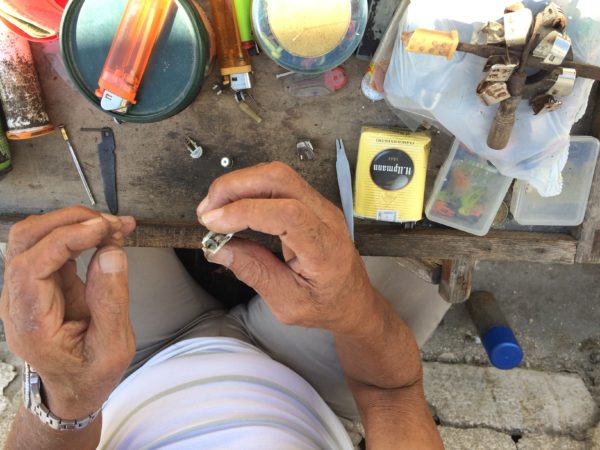
Usually, lighters are so cheap and mass-produced that in other places, abroad, businesses buy them, print their logos on them, and give them away as part of their marketing, aiming for brand visibility. As I mentioned, they’re very cheap —unless they’re luxury ones— which is why in other countries, very few people bother to refill them. However, in Havana, until recently, there was someone on almost every corner refilling them.
Refilling a lighter with a puff of gas and adding a flint to create a spark is expensive. A few years ago, I used to pay five pesos for both services; now they charge me fifty —almost half the cost of a new but cheap one.
So, I went out and walked the whole neighborhood, but I couldn’t find anywhere to refill my lighter. What’s going on? There’s no gas! So, this seemingly simple problem of not being able to light a burner can become a distressing sign that you’re at the mercy of a senseless hardship.
In an effort to break free from this situation and save money in the process, I made a homemade electric lighter. I connected it to the chassis of the gas stove and to the water pipe with a thin electric wire, running a live wire through a jar of saltwater to act as a resistor. The other terminal of the jar connects to the applicator that makes contact with the burner, creating the spark that lights the flame.
It’s easy, but not many people have the skills to do it, nor do they have the tools or the wire. In short, they don’t know how to make it. Plus, it only works when there’s electricity. And in this whole story, while you think you’re solving one problem, you realize you’re just falling into another.
This is what it feels like to live a miserable life, even if you’re a resourceful individual with certain skills. Those skills clash with the reality of struggling to do something that only solves half the problem because the real issue, the one causing all your limitations, is out of your control. That’s why it’s a problem.
Trying to solve it puts you outside the law. So, you vent —or at least you think you do— by talking about these things with people when you go out. That’s when I remember the story of the mice who realized they needed to put a bell on the cat, but the real drama was finding who would do it.