


WIN to seek fairer terms from oil contract
Jul 25, 2025
…plans to ring-fence oil projects
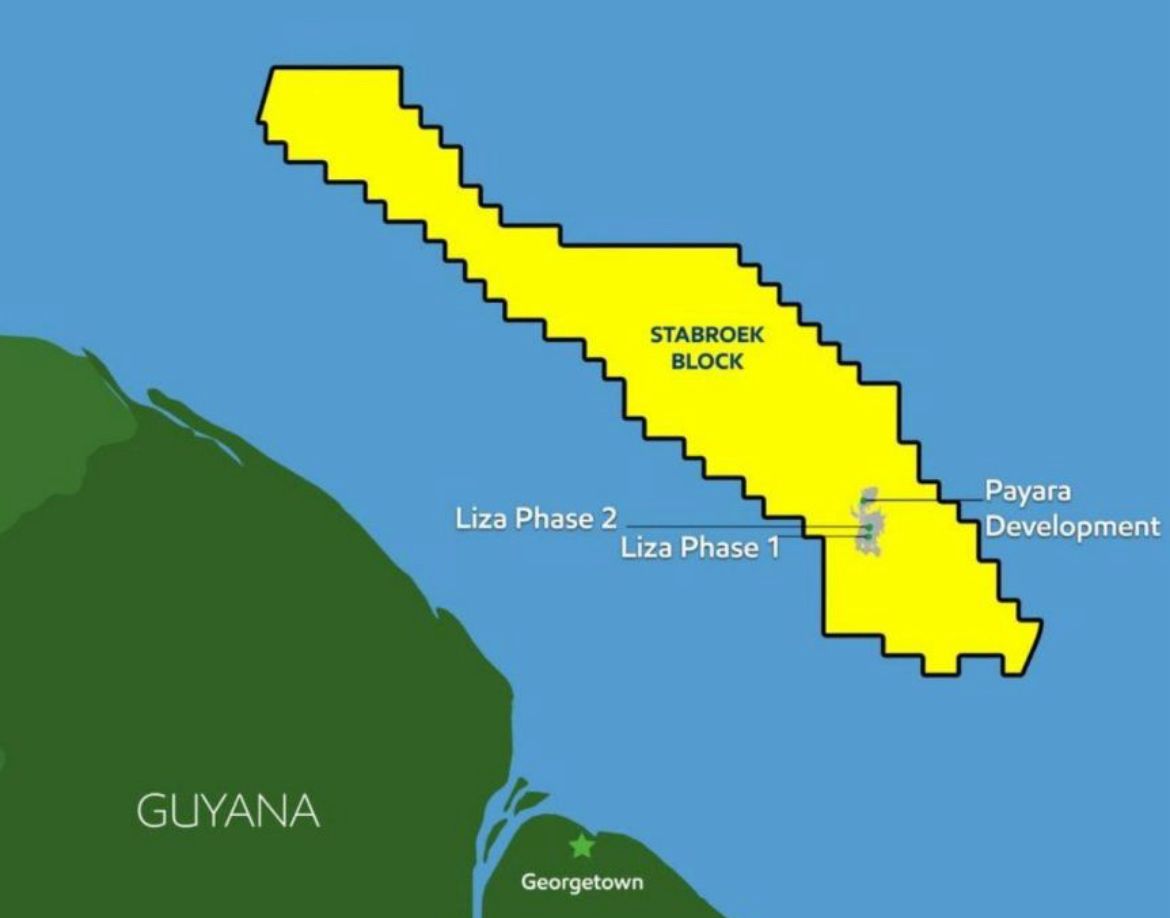
The Stabroek Block
Kaieteur News – We Invest in Nationhood (WIN) on Thursday unveiled its 2025 election campaign manifesto, pledging to seek fairer terms from the 2016 Production Sharing Agreement (PSA), a deal that has long faced criticism for favouring the oil companies over the country.
The party, launched just 59 days ago, hosted a press conference on Thursday to present its manifesto.
Pressed on WIN’s plans to review the oil and gas framework, the party’s presidential candidate, United States-sanctioned businessman Azruddin Mohamed, said, “We will engage with ExxonMobil when we take office, and we will try to ensure that we can ring- fence some of the projects, we’ll discuss this with them.”

WIN’s presidential candidate, Azruddin Mohamed
The Stabroek Block, which spans 6.6 million acres and holds about 11.6 billion barrels of oil equivalent, is operated by ExxonMobil Guyana Limited (EMGL), which holds a 45% stake. Its partners are Chevron (formerly Hess) with 30% and CNOOC with 25%.
A ring-fencing provision would require that only costs related to a specific development are recovered from that project once oil production begins. This would prevent ExxonMobil from charging unrelated expenses to the cost bank and help ensure a larger share of revenue is available for Guyana. Currently, the deal lacks such a provision and the Irfaan Ali led administration has approved new oil projects for Exxon without inserting a ring-fencing provision.
Further, the current agreement governing the Stabroek Block offers favourable terms to the oil companies. Under the PSA, the consortium can recover up to 75% of oil produced to cover investment costs. The remaining 25% is split equally between Guyana and the consortium, with each receiving 12.5%. From that, the consortium pays a 2% royalty to Guyana. Of Guyana’s total 14.5% take, the government is also responsible for paying the oil companies’ taxes.
The deal also stipulates that the amount equivalent to the taxes owed by the oil companies must be paid by the minister responsible for petroleum to the Commissioner General of the Guyana Revenue Authority (GRA).
Oil production began in December 2019 and has grown to 650,000 barrels per day (bpd) from three sanctioned projects: Liza Phase 1, Liza Phase 2, and Payara. This output is expected to increase with the upcoming start-up of Yellowtail, the fourth development, later this year. Exxon has two other sanctioned projects under its belt: Uaru and Whiptail. It has also submitted an Environmental Impact Assessment (EIA) for its seventh project, Hammerhead, with production targeted for 2029. Additionally, the company has filed an application for an eighth development, Longtail.
WIN’s manifesto highlights that almost six years after first oil, significant gaps remain in areas such as environmental protection, climate resilience, local content, workforce development, revenue management, and the legislative framework.
It states, “These gaps demand urgent attention if we are to truly safeguard our people and environment from the risks associated with a growing oil and gas sector.”
The party stresses the need for policies that prioritise building a capable workforce, ensuring that Guyanese are equipped with the necessary skills and are first in line for opportunities in the sector. It states, “The way we manage oil revenues can no longer be a source of division or doubt. Strong, transparent systems must be put in place; systems that foster full public trust and reflect our shared commitment to accountability, equity, and national development.”
WIN has promised to:
•Set and enforce internal deadlines aligned with the EITI reporting calendar to ensure timely reporting;
•Publish all extractive contracts in full, including annexes and fiscal terms, on a centralised, searchable portal;
•Guarantee the independent, protected, and active participation of civil society in the Multi-Stakeholder Group (MSG);
•Apply strict ring-fencing rules to all oil blocks.
Related
Similar Articles